




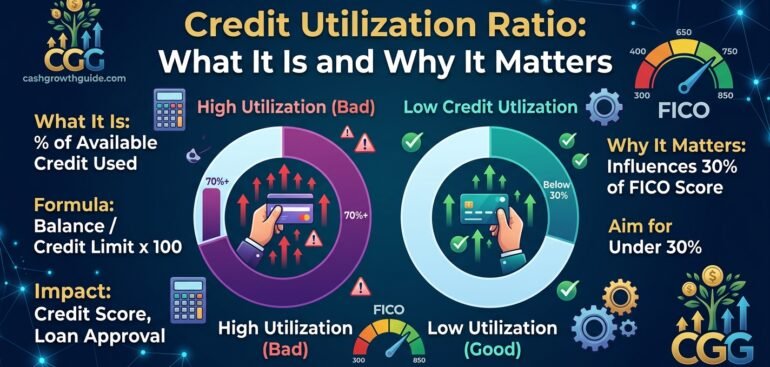
Credit Utilization Ratio: What It Is and Why It Matters

Credit utilization ratio explained with credit limit and balance

Your credit card balance can affect more than your monthly budget. It can also influence how lenders view your credit profile. One of the important measurements to understand is the credit utilization ratio.

Credit utilization shows how much of your available revolving credit you are currently using. If you have credit cards or other revolving accounts, understanding this ratio can help you manage balances more effectively and make informed financial decisions.

A lower utilization level is generally viewed more favorably by many credit scoring models. However, credit utilization is only one part of your overall credit profile. Payment history, credit history, new applications, and other factors can also matter.

At Cash Growth Guide, understanding everyday financial concepts can help you make better money decisions. This guide explains how credit utilization works, how to calculate it, what ideal credit utilization can look like, and how to manage your balances responsibly.

What Is a Credit Utilization Ratio?

The credit utilization ratio measures the percentage of your available revolving credit that you are using.

For example, suppose you have a total credit limit of $5,000 across your credit cards and your current balances add up to $1,000. Your credit utilization would be 20%.

The basic calculation is:

Credit Utilization Ratio = Total Credit Card Balances ÷ Total Credit Limits × 100

This calculation can be considered for an individual credit card as well as across multiple revolving accounts.

For example, if one card has a $2,000 limit and a $400 balance, the utilization for that card is 20%.

The ratio becomes useful because it puts your balance into context. A $500 balance may seem relatively small, but its impact can look different depending on whether your credit limit is $1,000 or $10,000.

Why Does Credit Utilization Matter?

Credit utilization matters because it can be one of the factors considered by credit scoring systems.

A high utilization ratio may indicate that you are relying heavily on available revolving credit. A lower ratio can show that a smaller portion of your available credit is being used.

However, utilization should not be viewed in isolation. A person with low utilization can still have credit problems if they frequently miss payments or have other negative information in their credit history.

Likewise, someone with a temporary increase in utilization may not necessarily have a long-term credit problem.

The goal is to understand the relationship between your credit limits and balances so you can manage your credit more carefully.

How to Calculate Credit Utilization Ratio

Calculating your credit utilization ratio is simple.

First, add together the balances on your revolving credit accounts. Next, add together the credit limits on those accounts. Finally, divide the total balances by the total limits and multiply the result by 100.

For example:

Imagine you have three credit cards:

  • Card A: $500 balance with a $2,000 limit
  • Card B: $700 balance with a $3,000 limit
  • Card C: $300 balance with a $5,000 limit

Your total balance is $1,500.

Your total credit limit is $10,000.

The calculation would be:

$1,500 ÷ $10,000 × 100 = 15%

Your overall credit utilization ratio would therefore be 15%.

This calculation can give you a quick snapshot of how much of your available revolving credit you are using.

What Is Ideal Credit Utilization?

There is no single percentage that guarantees a particular credit score. Credit scoring models can use different calculations and may consider information at different points in time.

Still, keeping utilization relatively low is a common credit-management strategy.

The concept of ideal credit utilization is often discussed because lower utilization may be viewed more positively than very high utilization. The important point is not to treat one percentage as a guaranteed scoring target.

For example, moving from 80% utilization to 30% can represent a meaningful reduction in revolving debt usage. Moving from 30% to 10% may also change the ratio, but the exact effect on a credit score can vary.

Instead of chasing a perfect number, focus on maintaining manageable balances and avoiding unnecessary dependence on available credit.

Individual Credit Card Utilization vs Overall Utilization

There are two utilization measurements you should understand.

The first is individual-card utilization. This looks at the balance and limit of a single credit card.

The second is overall utilization. This looks at your balances and limits across multiple revolving accounts.

For example, imagine you have two cards.

Card A has a $900 balance and a $1,000 limit. Card B has a $100 balance and a $4,000 limit.

Your overall utilization may appear relatively moderate when both cards are considered together. However, Card A itself is using a very high percentage of its available limit.

This is why looking only at your total utilization may not give you the complete picture.

Credit Utilization Calculator: How It Works

A credit utilization calculator can make the calculation faster.

You do not need a complicated formula. You simply need your current revolving balances and corresponding credit limits.

For a single account, enter:

Current Balance: $600
Credit Limit: $2,000

Then calculate:

$600 ÷ $2,000 × 100 = 30%

For multiple accounts, add the balances first and then add the credit limits.

For example:

Total balances: $2,000
Total limits: $10,000

Then:

$2,000 ÷ $10,000 × 100 = 20%

You can also perform the calculation manually using the formula above. The purpose of a credit utilization calculator is simply to make the process quicker and easier.

What Happens When Credit Utilization Is High?

High utilization means you are using a large percentage of your available revolving credit.

For example, if your credit limit is $4,000 and your balance is $3,600, your utilization is 90%.

A high ratio can be a warning sign that your available credit is becoming heavily used. It may also make your monthly payments harder to manage, especially if the balance continues to grow.

High utilization can also become expensive when interest charges accumulate.

The bigger concern is often not the percentage itself but the financial behavior behind it. If you repeatedly need most of your available credit to cover normal expenses, it may be useful to review your budget and spending patterns.

What Happens When Credit Utilization Is Low?

Low utilization means you are using a smaller portion of your available revolving credit.

For example, a $200 balance on a $5,000 credit limit represents 4% utilization.

Low utilization can provide more available credit for unexpected expenses. It can also reduce the risk of reaching your credit limit.

However, low utilization does not automatically mean your overall credit profile is strong.

You still need to pay bills on time, monitor your accounts, manage debt responsibly, and avoid unnecessary credit applications.

Credit management works best when utilization is treated as one part of a broader financial strategy.

Does Paying Your Credit Card in Full Help?

Paying your credit card balance in full can help you avoid carrying revolving debt from month to month and may reduce interest costs.

It can also help keep your balance under control.

However, your reported balance and your payment date are not necessarily the same thing. Credit information can be reported based on account activity at particular points in the billing cycle.

As a result, someone who pays the full balance each month could still have a balance reported at a particular time.

This is why understanding both your spending habits and reporting timing can be useful.

The main objective should be responsible repayment rather than trying to manipulate a particular number.

How to Lower Your Credit Utilization Ratio

If your utilization is higher than you want, there are several practical approaches you can consider.

Pay Down Existing Credit Card Balances

One of the most direct ways to reduce utilization is to reduce your revolving balances.

Start by reviewing the balances on each account. Then create a realistic repayment plan based on your income, essential expenses, and other financial obligations.

Even consistent payments can gradually reduce your outstanding balance.

Avoid Adding New Unnecessary Charges

Paying down a balance becomes harder if you continue adding new purchases to the same account.

Before using a credit card, consider whether the purchase fits within your current budget.

Credit cards can be useful financial tools, but they should not become a substitute for income.

Make Payments Before Balances Become Difficult to Manage

Waiting until a balance becomes very large can make repayment more stressful.

Regular payments can help you maintain better control over your revolving debt.

If your budget allows, you may choose to make payments throughout the billing cycle rather than relying only on one large payment.

Focus on High-Utilization Accounts

If you have several credit cards, identify the accounts that are using the largest percentage of their individual limits.

Reducing a card that is close to its limit can lower that card’s individual utilization.

At the same time, continue monitoring your overall debt so that your repayment strategy remains manageable.

Avoid Unnecessary Credit Limit Increases

A higher credit limit can reduce your utilization ratio if your balance stays unchanged. However, requesting additional credit should not be used as an excuse to spend more.

The important part is controlling the balance.

For example, increasing your limit from $5,000 to $8,000 does not solve a debt problem if your spending increases along with the limit.

Credit availability should support responsible financial management, not encourage additional borrowing.

Does Closing a Credit Card Affect Utilization?

Closing a credit card can change your available credit.

Suppose you have two cards with combined limits of $10,000 and balances of $2,000. Your overall utilization is 20%.

If you close an unused card with a $4,000 limit while keeping the same $2,000 balance, your available credit could fall to $6,000.

Your utilization would then become:

$2,000 ÷ $6,000 × 100 = 33.3%

This example shows why closing an account can change your utilization even when your balance has not changed.

Before closing an account, consider how its credit limit affects your overall profile and whether the account has other financial implications.

Can You Raise Your Credit Score Fast by Lowering Utilization?

People often search for ways to raise credit score fast, especially before applying for financing.

Reducing high credit utilization may help because utilization is one factor that can be considered in credit scoring. However, there is no universal shortcut that guarantees a specific score increase within a specific period.

Your credit score can depend on multiple pieces of information.

If your utilization is very high, paying down balances may improve the credit profile once the lower balances are reflected in the relevant credit information.

Still, it is better to focus on sustainable habits than temporary changes made only to achieve a short-term result.

Does Carrying a Credit Card Balance Improve Your Credit?

Carrying a balance does not automatically make your credit stronger.

You do not need to maintain credit card debt simply to demonstrate credit activity.

In fact, carrying unnecessary balances can result in interest charges and make debt harder to manage.

Responsible credit use is more important than intentionally paying interest. Use credit within your financial means and make payments according to your repayment plan.

Credit Utilization and Your Monthly Budget

Credit utilization is closely connected to budgeting.

If your credit card balance increases every month because your expenses are greater than your available income, lowering utilization may require more than making an occasional payment.

You may need to review your monthly spending.

Start by separating essential expenses from discretionary purchases. Then identify areas where spending can be reduced.

Once your budget becomes more realistic, you can direct additional money toward outstanding credit card balances.

This approach addresses the underlying financial behavior instead of focusing only on the utilization percentage.

How Credit Limits Affect Utilization

Your credit limit directly affects the utilization calculation.

Consider two people with identical $1,000 balances.

Person A has a $2,000 credit limit.

Person B has a $10,000 credit limit.

Person A has 50% utilization, while Person B has 10%.

The balance is exactly the same, but the utilization ratio is different because the available credit is different.

This is why understanding the ratio is more useful than looking at the balance alone.

However, a larger credit limit should never be treated as permission to increase spending.

Common Credit Utilization Mistakes

Many people make avoidable mistakes when managing revolving credit.

One common mistake is looking only at the total balance without considering the credit limit.

Another is assuming that carrying a balance automatically improves credit. It does not.

Some people also close old accounts without considering how the lost credit limit could affect their utilization.

Another mistake is making large purchases simply because enough credit is available.

Finally, some people focus heavily on utilization while ignoring payment history and other important aspects of credit management.

A balanced approach is usually more practical.

How Often Should You Check Your Credit Utilization?

You can check your credit utilization whenever you review your credit card balances and limits.

Monthly monitoring can be especially useful because it fits naturally into a regular financial routine.

You do not need to obsess over daily changes.

Instead, make credit review part of your broader money-management process. Check your balances, review upcoming payments, compare spending with your budget, and identify accounts that may require attention.

A consistent routine can help you spot problems before they become difficult to manage.

A Simple Strategy for Managing Credit Utilization

You can create a simple monthly credit-management routine.

Start by recording the balance and credit limit for each revolving account.

Next, calculate your individual utilization ratios and your overall ratio.

Then review your monthly budget and determine how much you can realistically put toward existing balances.

Avoid unnecessary purchases that could increase revolving debt.

Finally, continue making payments on time and review your progress regularly.

The goal is not to achieve a perfect utilization percentage overnight. The goal is to build habits that keep revolving debt manageable.

Credit Utilization vs Credit Score

Credit utilization and credit score are not the same thing.

Your utilization ratio is a measurement of revolving credit usage. Your credit score is a broader numerical assessment calculated using information from your credit history and other relevant data.

This distinction is important.

A low utilization ratio does not guarantee an excellent credit score. Similarly, a person may have a good credit profile while experiencing temporary changes in utilization.

Think of utilization as one piece of the larger credit picture.

Understanding this difference can prevent unrealistic expectations and help you focus on the financial habits you can control.

Final Thoughts on Credit Utilization Ratio

The credit utilization ratio is an important concept for anyone who uses revolving credit.

It shows how much of your available credit you are using and can help you understand how your balances relate to your credit limits.

Keeping utilization manageable, paying bills on time, avoiding unnecessary debt, and maintaining a realistic budget can all support responsible credit management.

Instead of focusing on a single magic percentage, pay attention to your overall financial behavior. Use a credit utilization calculator when you want a quick calculation, monitor individual and overall utilization, and make repayment decisions that fit your budget.

For more practical personal finance guidance, visit Cash Growth Guide and continue building a stronger understanding of budgeting, saving, debt management, and everyday money decisions.

Frequently Asked Questions

What is a credit utilization ratio?

A credit utilization ratio is the percentage of your available revolving credit that you are currently using. It is calculated by dividing your total revolving credit balances by your total credit limits and multiplying the result by 100.

What is considered ideal credit utilization?

There is no single utilization percentage that guarantees a specific credit score. Lower utilization is generally preferable to very high utilization, but credit scoring also considers other aspects of your credit profile.

How do I calculate my credit utilization?

Add your revolving credit balances, add your credit limits, divide total balances by total limits, and multiply by 100.

For example, $1,000 in balances divided by $5,000 in available credit equals 20% utilization.

Can a credit utilization calculator calculate multiple cards?

Yes. You can use the same basic formula for multiple cards by adding all balances together and all credit limits together before calculating the percentage.

Does high credit utilization hurt your credit score?

High utilization can negatively affect credit scores in some scoring models. The exact impact can vary depending on the scoring model and the rest of your credit profile.

Can I raise my credit score fast by paying down credit cards?

Reducing high revolving balances may help your credit profile once the updated information is reflected. However, there is no guaranteed timeframe or universal amount by which your score will increase.

Does paying my credit card in full help?

Paying the full balance can help you avoid carrying unnecessary revolving debt and interest charges. It can also help you maintain lower balances when managed consistently.

Should I keep a small balance on my credit card?

You do not need to carry a balance simply to build credit. Carrying unnecessary debt can create interest costs and make your finances harder to manage.

Does closing a credit card change utilization?

It can. Closing an account may reduce your total available credit. If your balances remain unchanged, your overall utilization ratio can increase.

Is credit utilization the only credit score factor?

No. Credit scoring can consider several types of information. Payment history, length of credit history, credit accounts, new applications, and other factors may also play a role.

How often should I calculate my credit utilization?

Checking it monthly can be a practical habit. You can calculate it whenever you review your credit card balances, limits, and monthly budget.

Can increasing my credit limit lower utilization?

If your balance remains unchanged, a higher credit limit can mathematically reduce your utilization ratio. However, increasing available credit should not lead to unnecessary spending or additional debt.
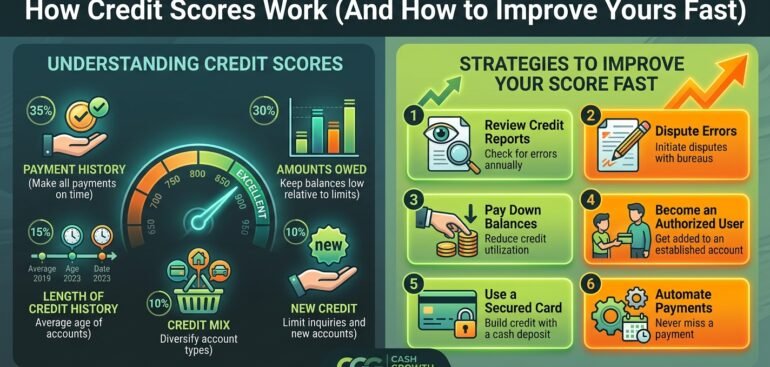
How Credit Scores Work (And How to Improve Yours Fast)

How to improve credit score with practical credit building tips

Your credit score can affect important financial decisions, including whether you qualify for certain loans or credit products and what terms you may receive. Yet many people do not fully understand how credit scores are calculated or what they can do to improve them.

If you have ever wondered why your credit score changed, how credit card balances affect it, or how to improve credit score results over time, understanding the basics is an important first step.

A credit score is generally calculated from information in your credit report. Different scoring models can use different information and produce different scores, so you may not have one universal number that every lender uses.

The good news is that many of the habits that support a stronger credit profile are practical and straightforward. Paying bills on time, keeping credit balances under control, limiting unnecessary applications, maintaining accounts responsibly, and checking your credit reports can all play a role.

In this guide, Cash Growth Guide explains how credit scores work, the major credit score factors, and practical steps you can take to raise credit score fast while building healthier long-term credit habits.

What Is a Credit Score?

A credit score is a numerical measure generated from information in your credit history. Scoring models use information from credit reports to estimate how likely you are to repay borrowed money as agreed.

Credit scores are used in decisions involving products such as loans and credit cards. Depending on the situation, credit information can also be considered in areas such as rental applications and insurance.

Many commonly used credit scores fall within a range of 300 to 850, although the exact range depends on the scoring model.

This means your credit score is not simply a grade that never changes.

It can change as information in your credit reports changes.

For example, a newly reported payment, a change in credit card balances, a new account, or an updated account status may affect your score.

Credit Score vs. Credit Report

A credit report and a credit score are not the same thing.

Your credit report contains information about your credit accounts and borrowing history.

Your credit score is calculated using information from your credit report.

Think of your credit report as the information and your credit score as a number generated from that information.

This distinction is important because improving your score often starts with understanding and managing the information contained in your credit reports.

Credit reports can contain information about payment history, account balances, credit accounts, and other aspects of your credit history. Errors in those reports can potentially affect your score, which is why reviewing your reports is an important part of credit management.

Why Does Your Credit Score Matter?

Your credit score can influence how lenders evaluate applications for credit.

A stronger score may make it easier to qualify for certain financial products and may help you receive more favorable borrowing terms, although approval decisions depend on many factors beyond the score itself.

Your credit history can become important when you are:

  • Applying for a credit card
  • Applying for a personal loan
  • Financing a vehicle
  • Applying for a mortgage
  • Renting a home
  • Managing existing credit
  • Planning future borrowing

This is why building good credit is not just about reaching a particular number.

It is about developing a history that shows responsible management of borrowed money.

How Credit Scores Work

Credit scoring models analyze information from your credit history and use mathematical formulas to produce a score.

There is no single formula that determines every credit score.

Different lenders may use different scoring models, different credit reporting information, or scores calculated at different times. As a result, it is normal for a person to see different credit scores depending on where and when the score is obtained.

This is important to remember when you are trying to improve your credit.

Do not become overly focused on a single score.

Instead, focus on the financial behaviors that generally support healthy credit management.

The Main Credit Score Factors

Understanding the major credit score factors can help you make better decisions.

Different scoring models can weigh factors differently, but commonly considered information includes payment history, unpaid debt and balances, credit utilization, length of credit history, types of credit accounts, new credit applications, and certain negative events.

1. Payment History

Payment history is one of the most important parts of your credit profile.

It reflects whether you have made required payments on time.

Late payments can negatively affect your credit history, while consistently making payments on time can help establish a stronger record.

If you have missed payments in the past, that does not mean your credit can never improve.

The important step is to get current and continue making future payments on time.

Setting up automatic payments or payment reminders can help reduce the chance of accidentally missing a due date.

2. Credit Utilization

Credit utilization refers to how much of your available revolving credit you are using.

For example, if you have a total credit limit of $10,000 and balances of $2,000, your utilization would be 20%.

A lower utilization rate is generally viewed more favorably by scoring models than being close to your credit limits.

Some consumer guidance recommends keeping credit utilization below 30%, although lower utilization can also be beneficial and scoring models differ.

You also do not need to carry a credit card balance to build credit.

Paying the balance in full each month can help you avoid unnecessary interest while maintaining responsible payment behavior.

3. Length of Credit History

The length of time you have managed credit can also matter.

A longer history provides more information about how you have handled credit over time.

This is one reason you should think carefully before closing older credit accounts.

Closing an account can sometimes affect your overall credit utilization and may have other effects depending on your credit profile.

However, keeping an account open is not automatically the right decision in every situation. Fees, account terms, and your ability to manage the account responsibly should also be considered.

4. Types of Credit

Your credit profile can contain different types of accounts, such as credit cards and installment loans.

Credit scoring models may consider the types of credit accounts you have.

However, you should not open accounts simply to create a particular mix of credit.

Applying for credit you do not need can create unnecessary inquiries and new accounts.

Focus first on managing the credit you already have responsibly.

5. New Credit Applications

Applying for several new credit accounts within a short period can affect your credit profile.

Frequent applications may signal that you are seeking additional credit, and new applications can result in credit inquiries.

This does not mean you should never apply for credit.

Instead, apply when you have a genuine financial need and understand the terms of the product you are considering.

6. Negative Credit Information

Certain negative events can affect your credit profile.

These may include:

  • Missed payments
  • Accounts sent to collections
  • Foreclosure
  • Bankruptcy
  • Significant unpaid debt

The effect of negative information can vary depending on the type of information, how recent it is, and the scoring model being used.

Recent negative information can have a greater impact than older information, and accurate negative information cannot simply be removed because someone wants a faster score increase.

How to Improve Credit Score

If you are wondering how to improve credit score, start with the factors you can directly influence.

There is no secret shortcut that guarantees a specific increase by a specific date.

Instead, focus on consistent credit habits.

1. Pay Every Bill on Time

The first habit to improve is payment consistency.

Create a system that makes it easier to pay every account by its due date.

You can use:

  • Automatic payments
  • Calendar reminders
  • Payment alerts
  • A monthly bill checklist

If you have already missed payments, bring your accounts current as soon as possible and focus on maintaining timely payments going forward.

Consistency matters because your future payment history becomes part of your ongoing credit record.

2. Reduce High Credit Card Balances

High credit utilization can put pressure on your credit profile.

If your credit cards are close to their limits, reducing the balances may help your utilization ratio.

For example, suppose your total credit limit is $8,000 and your current balances are $4,000.

Your utilization is:

$4,000 ÷ $8,000 = 50%

Reducing the balance to $2,000 would bring utilization to:

$2,000 ÷ $8,000 = 25%

The exact score impact depends on the scoring model and the rest of your credit profile.

Still, keeping balances well below your limits is generally a useful credit-management habit.

3. Pay Credit Card Balances in Full When Possible

Carrying a balance does not help you build a better credit score.

You can use a credit card and pay it off in full each month.

Doing this can help you avoid unnecessary interest charges while keeping your payment history strong.

If paying the full balance is not currently possible, focus on making at least the required payment on time and work toward reducing the balance.

4. Avoid Maxing Out Your Credit Cards

A credit card that is consistently near its limit can result in high utilization.

Even if you make your required payments on time, a high reported balance may still affect your score.

If possible, keep your balances comfortably below the available limits.

Avoid treating your full credit limit as money you can spend.

Your credit limit is a borrowing limit, not an income increase.

5. Avoid Unnecessary New Credit Applications

If you are actively trying to improve your credit, avoid applying for multiple accounts simply to increase your available credit.

Every application should have a clear reason.

Before applying, consider:

  • Do I actually need this credit?
  • Can I afford the payments?
  • What are the fees and interest costs?
  • Will this account improve my financial situation?
  • Can I manage another account responsibly?

Credit improvement should focus on healthier financial behavior, not simply collecting more accounts.

6. Review Your Credit Reports

Credit reports can contain mistakes.

Check your reports for information that appears inaccurate or does not belong to you.

Look for:

  • Incorrect personal information
  • Accounts you do not recognize
  • Incorrect payment history
  • Accounts reported as open when they were closed
  • Duplicate information
  • Incorrect balances

If you identify an error, follow the dispute process provided with your credit report and contact the relevant reporting company and information provider as appropriate.

7. Be Careful About Closing Old Accounts

Closing a credit card is not automatically a way to improve your credit score.

Depending on your situation, closing an account may reduce your available credit and increase your utilization ratio.

It can also remove an account from your active credit profile.

Before closing an old account, consider:

  • Annual fees
  • Interest rates
  • Your spending habits
  • Available credit
  • Existing balances
  • Your future borrowing plans

The right decision depends on your individual circumstances.

8. Keep Your Credit Accounts Organized

Managing multiple accounts can become difficult.

Create a simple list containing:

  • Account name
  • Payment due date
  • Minimum payment
  • Current balance
  • Credit limit
  • Interest rate

Review this information regularly.

Organization can help you avoid missed payments and identify which balances should receive additional attention.

9. Focus on Debt Reduction

Reducing debt can improve your overall financial position and may also reduce credit utilization when revolving balances decline.

Start by making all required payments on time.

Then, if your budget allows, direct additional money toward high-priority debt.

Do not sacrifice essential expenses or required payments simply to make an aggressive debt payment.

A sustainable plan is easier to maintain.

10. Do Not Believe in Instant Credit Repair Promises

If someone promises to remove accurate negative information immediately or guarantees a specific score increase, be cautious.

Accurate negative information generally cannot simply be erased because you pay someone to do it.

Building or rebuilding credit takes time and consistent financial behavior.

Be especially careful with any service that promises a guaranteed score increase without first understanding your credit situation.

How to Raise Credit Score Fast

If your goal is to raise credit score fast, focus first on changes that can realistically affect your current credit profile.

There is no guaranteed timeline for a particular number of points.

However, several practical steps can help you address issues that may be affecting your score.

Check for Credit Report Errors

If incorrect information is affecting your report, identifying and disputing the error may be important.

Reduce High Credit Utilization

If your revolving balances are high compared with your available limits, paying them down may improve the utilization portion of your profile when updated information is reflected.

Bring Missed Payments Current

If you have fallen behind, getting current and staying current is an important step toward rebuilding your payment history.

Avoid New Applications

If you do not need additional credit, avoid unnecessary applications while you work on improving your existing profile.

Continue Good Habits

Fast improvement is not the same as permanent improvement.

A temporary score increase is less useful if your financial habits later cause the score to fall again.

The strongest approach is to combine short-term improvements with long-term consistency.

Can Paying Off a Credit Card Improve Your Credit Score?

Paying off a credit card can be beneficial for your overall finances and may improve your credit profile by reducing your credit utilization.

However, the exact effect on your score depends on the information being reported and the scoring model being used.

You do not need to maintain a credit card balance to demonstrate responsible credit use.

Paying the balance in full each month can help you avoid interest charges while maintaining timely payments.

How Long Does It Take to Improve a Credit Score?

There is no universal timeline.

Your score can change when new information is reported, but the amount and timing of change depend on your individual credit history and the scoring model.

For example, paying down a high balance may affect your score after the lower balance is reported.

Building a strong payment history generally takes longer because it requires consistent behavior over time.

This is why improving credit should be viewed as both a short-term and long-term process.

What Can Hurt Your Credit Score?

Several actions can potentially hurt your credit profile.

These include:

  • Missing payments
  • Carrying very high revolving balances
  • Applying for unnecessary credit
  • Opening multiple new accounts quickly
  • Closing accounts without considering the consequences
  • Allowing accounts to go into collections
  • Ignoring errors on your credit reports

Understanding these risks can help you avoid mistakes that may be difficult to correct later.

Credit Score Improvement Plan

If you want a simple action plan, start with these steps.

Week 1: Understand Your Credit

Review your credit reports and identify your current accounts, balances, payment history, and any potential errors.

Week 2: Organize Payments

Set up reminders or automatic payments where appropriate.

Make sure you know every payment due date.

Week 3: Review Credit Utilization

Calculate how much of your available revolving credit you are currently using.

Identify balances that you can realistically reduce.

Week 4: Review Your Progress

Check whether:

  • Payments are current
  • Balances are decreasing
  • Utilization is improving
  • Errors have been identified
  • Unnecessary applications have been avoided

Then continue the process every month.

What If Your Credit Score Is Very Low?

A low score does not mean you cannot improve your credit situation.

Start with the basics.

Make required payments on time.

Reduce high balances where possible.

Review your credit reports.

Avoid unnecessary new credit.

Give your credit history time to improve.

If you are struggling to make required payments, address the financial problem directly instead of taking on additional debt simply to make your credit profile look better.

The goal is to create sustainable financial habits.

Building Credit When You Have Little or No Credit History

If you are new to credit, your situation can be different from someone rebuilding damaged credit.

You may have limited information in your credit history.

Some financial products are specifically designed to help people establish or rebuild credit, including secured credit cards and certain credit-builder products. The terms and costs should be reviewed carefully before opening any account.

The most important habit is to use credit responsibly and make payments on time.

Common Credit Score Myths

Myth 1: You Need to Carry a Balance

You do not need to carry a credit card balance to build credit.

Paying your balance in full can help you avoid interest while maintaining responsible payment behavior.

Myth 2: Checking Your Own Credit Always Hurts Your Score

Reviewing your own credit information is part of responsible financial management. The type of inquiry matters, and checking your own reports is not the same as applying for new credit.

Myth 3: Closing a Credit Card Automatically Improves Your Score

Closing an account can sometimes have the opposite effect, especially if it causes your utilization ratio to increase.

Myth 4: There Is a Guaranteed Fast Fix

There is no guaranteed shortcut for correcting accurate negative credit information.

Time and responsible credit management are important parts of rebuilding credit.

How to Maintain a Good Credit Score

Improving your score is only part of the process.

Once your credit profile improves, continue the habits that helped you get there.

Make payments on time.

Keep balances manageable.

Avoid unnecessary applications.

Monitor your credit reports.

Maintain accounts responsibly.

Review your financial situation regularly.

Think of credit management as a long-term habit rather than a one-time project.

Final Thoughts

Understanding how to improve credit score results starts with understanding how credit scoring works.

Your credit score is based on information in your credit history, and different scoring models can evaluate that information differently. Common credit score factors include payment history, credit utilization, length of credit history, types of credit, new credit activity, and certain negative information.

If you want to raise credit score fast, focus on practical actions that address your current situation. Pay bills on time, reduce high credit card balances, avoid unnecessary applications, review your credit reports for errors, and manage existing accounts responsibly.

Do not expect an overnight transformation.

A better credit profile is usually built through repeated positive financial behavior.

The most important thing is to start with the areas you can control and stay consistent.

Cash Growth Guide provides practical personal finance guidance to help you understand money management, budgeting, saving, debt, and credit-related topics. Use the information in this guide as a starting point for building better financial habits and making more informed decisions about your credit.

Frequently Asked Questions

How can I improve my credit score?

To improve your credit score, focus on paying bills on time, keeping credit card balances low relative to your limits, avoiding unnecessary new credit applications, maintaining accounts responsibly, and checking your credit reports for errors.

How can I raise my credit score fast?

To potentially raise credit score fast, focus on current issues such as high credit utilization, missed payments, or inaccurate information on your credit reports. However, there is no guaranteed number of points or timeline for improvement.

What are the main credit score factors?

Common credit score factors include payment history, current debt and balances, credit utilization, length of credit history, types of credit accounts, new credit applications, and certain negative credit events. Different scoring models can weigh these factors differently.

Does paying my credit card in full improve my credit score?

Paying your credit card balance in full each month can support responsible credit management and helps you avoid interest charges. Your score may also be affected by the balance reported at the time your score is calculated.

Does carrying a credit card balance help build credit?

No. You do not need to carry a balance to build credit. Making payments on time and managing your available credit responsibly are more important habits.

How much of my credit limit should I use?

Lower credit utilization is generally better than being close to your credit limit. Consumer guidance commonly suggests keeping utilization below 30%, although lower utilization may be beneficial and scoring models differ.

Can paying off debt improve my credit score?

Paying down revolving debt can reduce your credit utilization and may improve your score when updated balances are reported. The exact impact depends on your complete credit profile and the scoring model used.

Does closing a credit card hurt your credit score?

It can. Closing an account may reduce your available credit and increase your utilization ratio, which can negatively affect your score depending on your situation.

How long does it take to rebuild credit?

There is no fixed timeline. Some changes may appear after new account information is reported, while rebuilding a strong payment history generally requires consistent responsible behavior over time.

Can I improve my credit score without taking on more debt?

Yes. You do not need to take on unnecessary debt to improve your credit. Paying existing accounts on time, reducing balances, checking your reports, and avoiding unnecessary applications are important steps.

What should I do if I find an error on my credit report?

Review the information carefully and follow the dispute instructions provided with your credit report. You can generally contact the credit reporting company and the company that supplied the information to challenge inaccurate information.

Can a credit repair company guarantee a fast score increase?

Be cautious of guarantees. Accurate negative information cannot simply be removed because someone promises a quick fix. Rebuilding credit generally requires correcting genuine errors and maintaining responsible credit behavior over time.

Does having multiple credit cards improve your credit score?

Not necessarily. Having more accounts does not automatically create a better score. What matters is how you manage the accounts, including payment history, balances, utilization, and new credit activity.

What is the most important thing I can do for my credit?

Consistently paying your bills on time is one of the most important credit habits. Combine that with responsible credit utilization, limited unnecessary applications, and regular credit-report reviews for a stronger overall approach.

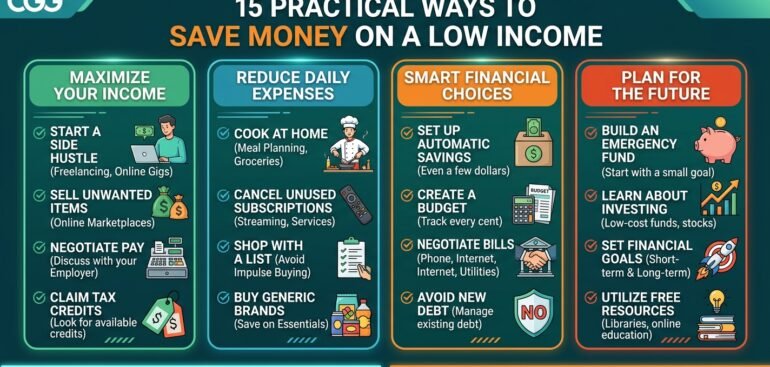
15 Practical Ways to Save Money on a Low Income

An illustration of five steps for building an emergency fund, featuring various money and banking icons and diagrams. The steps include: Set a Goal, Start Small, Create a Separate Account, Automate Savings, and Track Progress. The illustration has a modern, clean look with a dark background and orange, teal, and blue accents.

Saving money can feel difficult when your income is limited. After paying rent, utilities, groceries, transportation, debt payments, and other necessary expenses, there may seem to be little or nothing left to save.

But having a low income does not mean saving money is impossible.

The key is to focus on realistic changes that fit your current financial situation. You do not need to completely change your lifestyle or save a huge amount every month. Small amounts saved consistently can create a useful financial cushion over time.

Learning how to save money on a low income starts with understanding where your money goes, identifying expenses you can control, and creating a simple system that you can actually maintain.

In this guide, Cash Growth Guide explains 15 practical ways to reduce unnecessary spending, save more from a limited income, and make progress even when you are living paycheck to paycheck.

Why Saving Money on a Low Income Feels Difficult

Before discussing specific strategies, it is important to understand why saving can be challenging when your income is limited.

Many people have fixed expenses that consume a large percentage of their monthly income. Housing, food, transportation, utilities, healthcare, and debt payments are often difficult to reduce quickly.

This means telling someone to “just spend less” is not always helpful.

Instead, the goal should be to identify realistic opportunities to improve your financial situation without creating an unrealistic budget.

You may start by saving a small amount, reducing one unnecessary expense, or finding a way to increase your income.

The most important thing is to make progress without creating a financial plan that you cannot follow.

How to Save Money on a Low Income

There is no single trick that will suddenly create hundreds of dollars in savings.

Instead, saving money usually comes from several small improvements working together.

The following 15 strategies can help you build better money habits and create room for savings.

1. Create a Simple Monthly Budget

The first step in learning how to save money on a low income is understanding exactly where your income goes.

A budget gives your money a purpose before you spend it.

Start by writing down your monthly income and then list your expenses.

Include:

  • Rent or mortgage
  • Utilities
  • Groceries
  • Transportation
  • Insurance
  • Debt payments
  • Healthcare
  • Phone and internet
  • Personal expenses
  • Entertainment
  • Savings

Once everything is written down, compare your total expenses with your income.

This can reveal areas where your spending may be higher than expected.

A budget does not mean you cannot spend money on things you enjoy. It simply helps you decide how much you can realistically afford.

If you need help organizing your monthly finances, Cash Growth Guide provides practical personal finance guidance to help you build a clearer money-management routine.

2. Track Every Expense for 30 Days

If you are not sure where your money is going, track every expense for one month.

Write down even small purchases.

A $3 coffee may not seem important, but repeated small purchases can become a noticeable monthly expense.

Track:

  • Groceries
  • Snacks
  • Transportation
  • Online purchases
  • Subscriptions
  • Dining out
  • Entertainment
  • Personal spending
  • Bills
  • Other purchases

After 30 days, review your spending.

Look for patterns.

You may discover that certain expenses are consuming more money than you realized.

Once you know where your money is going, you can make better decisions about where to reduce spending.

3. Separate Needs From Wants

One of the most useful frugal living tips is learning the difference between needs and wants.

Needs are expenses required for your basic lifestyle and responsibilities.

Examples include:

  • Housing
  • Basic food
  • Essential utilities
  • Necessary transportation
  • Healthcare
  • Required debt payments

Wants are expenses that can improve your lifestyle but are not essential.

Examples include:

  • Restaurant meals
  • Entertainment
  • New clothes when existing clothes are sufficient
  • Premium subscriptions
  • Expensive hobbies
  • Non-essential upgrades

This does not mean you should eliminate every want.

Instead, ask yourself whether a purchase is necessary before spending the money.

If your income is limited, prioritizing needs can create more room for savings.

4. Reduce Grocery Costs

Food is an essential expense, but there may still be ways to reduce your grocery bill.

Start by planning your meals before shopping.

Create a shopping list based on meals you actually intend to prepare.

Avoid buying large quantities of items simply because they appear inexpensive.

You can also:

  • Compare prices
  • Use ingredients across multiple meals
  • Cook larger portions
  • Reduce food waste
  • Use leftovers
  • Buy only what you need
  • Plan meals around ingredients already at home

Small changes in grocery spending can make a meaningful difference over several months.

If you save even $30 each month, that becomes $360 over a year.

5. Cut Unused Subscriptions

Subscriptions can quietly reduce your available income.

Review recurring charges for:

  • Streaming services
  • Apps
  • Fitness memberships
  • Software
  • Online services
  • Subscription boxes
  • Other recurring memberships

Ask yourself how frequently you actually use each service.

If you are paying for something you rarely use, canceling it can create an immediate monthly saving.

You do not need to cancel everything.

Focus on subscriptions that provide little value compared with their cost.

6. Use a “No-Spend” Period

A short no-spend period can help you become more aware of unnecessary purchases.

During a no-spend week, avoid non-essential purchases.

Continue paying for necessary expenses such as housing, utilities, groceries, transportation, and healthcare.

The purpose is not punishment.

It is awareness.

You may discover how often you normally spend money simply because something is convenient or appealing.

After the week ends, identify which purchases you can reduce permanently.

You can repeat a no-spend week occasionally when you need to reset your spending habits.

7. Save Money Automatically

Saving becomes easier when you do not have to make the same decision every month.

If possible, set up an automatic transfer into your savings account after receiving your income.

The amount does not have to be large.

For example:

$25 per month = $300 per year

$50 per month = $600 per year

$100 per month = $1,200 per year

The exact amount depends on your financial situation.

The goal is to create consistency.

Even if you start with $10 or $20, establishing the habit can be more important than the initial amount.

8. Build a Small Emergency Fund

Unexpected expenses can make saving difficult.

A vehicle repair, medical bill, urgent home expense, or temporary loss of income can quickly consume your available money.

This is why building an emergency fund should be one of your financial priorities.

You do not need to start with a huge target.

Begin with a small amount that feels achievable.

For example:

First goal: $100

Then:

$250 → $500 → $1,000 → larger emergency fund

The appropriate long-term target depends on your essential monthly expenses and financial circumstances.

The important thing is to start creating a financial cushion.

9. Reduce Transportation Costs

Transportation can take a significant portion of a limited income.

Review how much you spend on:

  • Fuel
  • Public transportation
  • Parking
  • Vehicle maintenance
  • Insurance
  • Ride services
  • Vehicle payments

Look for realistic ways to reduce these expenses.

Depending on your circumstances, you might combine errands into fewer trips, use public transportation when practical, carpool, walk for short distances, or reduce unnecessary driving.

Even small reductions in transportation costs can create additional money for savings.

10. Cook More Meals at Home

Eating out and ordering food can become expensive when repeated frequently.

Cooking at home gives you more control over your food budget.

You do not need to prepare complicated meals.

Simple meals using affordable ingredients can be enough.

Try planning several meals at the beginning of the week and preparing extra portions for later.

If you normally spend $10 on a meal outside the home several times each week, replacing some of those meals with home-cooked alternatives can create noticeable savings.

You can still enjoy eating out occasionally.

The goal is to make it an intentional expense rather than an automatic habit.

11. Use the 24-Hour Rule Before Buying

Impulse purchases can be particularly harmful when you are trying to save money.

One simple strategy is to wait 24 hours before buying something that is not essential.

Ask yourself:

  • Do I really need it?
  • Do I already own something similar?
  • Can I afford it without affecting my savings?
  • Will I still want it tomorrow?
  • Does it support my current financial goals?

Sometimes the desire disappears after waiting.

If you still want the item after 24 hours and it fits your budget, you can make a more informed decision.

12. Reduce Energy and Utility Costs

Utility bills may not be completely under your control, but small changes can sometimes reduce your monthly costs.

Consider:

  • Turning off unused lights
  • Unplugging devices when appropriate
  • Using energy-efficient lighting
  • Adjusting heating or cooling settings
  • Reducing unnecessary water usage
  • Using appliances efficiently

The savings from individual changes may be small, but recurring savings can add up.

If you save $15 per month, that is $180 over a year.

The goal is to find changes that are easy enough to maintain.

13. Find Ways to Increase Your Income

Saving is only one side of the equation.

When your income is extremely limited, there may be a point where cutting expenses is no longer enough.

Increasing income can give you additional room to save.

Depending on your skills and circumstances, you might consider:

  • Freelance work
  • Part-time work
  • Selling unused items
  • Offering a skill as a service
  • Taking additional shifts
  • Small business opportunities
  • Learning a skill that can improve future earning potential

You do not need to immediately start multiple side jobs.

Even a modest increase in income can help.

For example, an additional $200 per month could potentially be divided between savings, debt payments, and essential expenses.

14. Use Extra Money Strategically

Unexpected or occasional money can provide a useful opportunity to improve your financial situation.

Examples include:

  • Work bonuses
  • Gifts
  • Refunds
  • Extra freelance income
  • Overtime payments
  • Money from selling unused items

You do not have to save all of it.

Instead, consider dividing it according to your priorities.

For example:

50% → Savings

30% → Debt

20% → Personal spending

The exact percentages can change depending on your situation.

The important idea is to avoid allowing unexpected money to disappear entirely through unplanned spending.

15. Create a Paycheck-to-Paycheck Savings Strategy

If you are trying to save money paycheck to paycheck, you may feel that there is no money available for savings.

In that situation, start extremely small.

Instead of saying, “I need to save $500 this month,” start with an amount that you know you can manage.

For example:

  • $5 per paycheck
  • $10 per paycheck
  • $20 per paycheck
  • $25 per paycheck

If you receive two paychecks per month and save $25 from each:

$25 × 2 = $50 per month

Over one year:

$50 × 12 = $600

As your financial situation improves, increase the amount.

The objective is to build a habit that survives even when money is tight.

Frugal Living Tips That Actually Make a Difference

Frugal living does not mean refusing to spend money on everything.

It means being intentional about how you use your resources.

Some practical frugal living tips include:

Buy Based on Value, Not Price Alone

The cheapest product is not always the best financial choice.

Consider how long something will last and whether you actually need it.

Repair When Practical

If something can be repaired affordably instead of replaced, compare the options before purchasing something new.

Use What You Already Own

Before shopping, check whether you already have something that can solve the problem.

Plan Purchases

Planned purchases are usually easier to fit into a budget than spontaneous ones.

Avoid Lifestyle Inflation

When your income increases, you do not have to immediately increase every expense.

Consider directing some of the additional income toward savings or financial goals.

How to Save Money When You Are Living Paycheck to Paycheck

Living paycheck to paycheck can make saving feel impossible.

The first goal should not necessarily be building a massive savings account.

Focus on creating a small buffer.

Start by calculating your essential expenses.

Then identify one expense you can reduce.

Take the amount saved and move it into a separate savings category.

Repeat the process.

For example:

You cancel a $15 subscription.

You reduce restaurant spending by $25.

You save $20 from grocery planning.

You reduce transportation spending by $15.

That creates:

$15 + $25 + $20 + $15 = $75

Instead of looking for one huge expense to eliminate, several small changes can create a meaningful monthly difference.

Create a Weekly Money Check-In

A weekly money check-in can help you stay aware of your finances.

Spend 10 to 15 minutes reviewing:

  • Current account balance
  • Recent purchases
  • Upcoming bills
  • Savings progress
  • Debt payments
  • Spending categories

Ask yourself:

Am I following my plan?

Did an unexpected expense appear?

Can I reduce anything next week?

This simple habit can prevent small problems from becoming larger financial issues.

Give Every Dollar a Purpose

When money is limited, every dollar matters.

Instead of thinking only about how much money you have, think about what that money needs to accomplish.

For example:

  • Housing money pays your rent.
  • Grocery money provides food.
  • Transportation money gets you to work.
  • Savings money builds your financial cushion.
  • Debt money reduces what you owe.
  • Personal spending money gives you controlled flexibility.

Giving your income specific purposes can make it easier to avoid unnecessary spending.

What If You Cannot Save Anything Right Now?

Sometimes your financial situation may genuinely leave no room for savings.

If your essential expenses are higher than your income, the first priority may be stabilizing your monthly finances.

Review your budget carefully.

Look for expenses that can be reduced.

Then consider whether you can increase your income.

Do not feel ashamed if you cannot save a large amount immediately.

Financial progress is not always linear.

Your first goal might simply be to stop increasing debt, reduce one recurring expense, or create a $50 emergency cushion.

Once your financial situation improves, you can increase your savings.

How Much Should You Save on a Low Income?

There is no universal amount that everyone should save.

Your savings target depends on:

  • Income
  • Essential expenses
  • Debt
  • Family responsibilities
  • Financial goals
  • Job stability
  • Existing savings

If your budget is very tight, start with an amount that does not force you to miss essential payments.

For some people, that may be $10 per paycheck.

For others, it may be $50, $100, or more.

Consistency matters.

A small amount saved regularly is better than setting an unrealistic goal that you cannot maintain.

A Simple Low-Income Savings Plan

Here is an example of how someone might organize their finances.

Suppose monthly income is $2,500.

Essential expenses:

  • Housing: $900
  • Utilities: $200
  • Groceries: $350
  • Transportation: $200
  • Insurance: $150
  • Debt payments: $250

Total essential expenses:

$2,050

Remaining:

$450

The person could allocate the remaining amount toward:

  • Emergency savings: $150
  • Future expenses: $100
  • Personal spending: $100
  • Entertainment: $50
  • Miscellaneous: $50

This is only an example.

Your numbers will be different.

The purpose is to show how even a limited income can be divided into clear categories when you create a realistic plan.

Common Mistakes When Trying to Save on a Low Income

Trying to Save Too Much Too Quickly

Setting an extremely aggressive goal may make your budget unsustainable.

Start with an amount you can maintain.

Cutting Everything You Enjoy

A budget with no flexibility can be difficult to follow.

Leave room for reasonable personal spending.

Ignoring Small Expenses

Small purchases can add up.

Track them so you understand their total impact.

Forgetting Irregular Expenses

Annual and occasional expenses can disrupt your savings if you do not plan for them.

Create a category for future expenses.

Giving Up After One Bad Month

Unexpected expenses happen.

If you spend more than planned one month, review what happened and start again.

One difficult month does not erase your progress.

How to Stay Motivated While Saving Money

Saving money can take time, especially when your income is limited.

Instead of focusing only on a large long-term goal, celebrate smaller milestones.

For example:

$100 saved

Then:

$250 saved

Then:

$500 saved

Then:

$1,000 saved

Each milestone represents progress.

You can also track the amount of money you save each month and compare it with previous months.

The goal is not perfection.

The goal is improvement.

Final Thoughts

Learning how to save money on a low income requires patience, realistic planning, and consistency.

You do not need to make dramatic changes overnight.

Start by creating a simple budget and tracking where your money goes. Separate needs from wants, reduce unnecessary recurring expenses, plan your groceries, cook more meals at home, and avoid impulse purchases.

If you are trying to save money paycheck to paycheck, start with a small amount that you can realistically maintain. Even $5 or $10 per paycheck can help you build the habit of saving.

Use these frugal living tips as a starting point, but remember that not every strategy will work for everyone.

Your financial situation is unique.

Choose the changes that fit your income, responsibilities, and lifestyle.

Most importantly, do not measure your progress only by the size of your savings account. Better financial habits, lower unnecessary spending, and greater awareness of your money are also meaningful forms of progress.

Cash Growth Guide is focused on helping you understand practical personal finance strategies so you can make more informed decisions about your money.

Start small, stay consistent, and improve your financial system one step at a time.

Frequently Asked Questions

How can I save money on a low income?

Start by creating a realistic budget, tracking your expenses, reducing unnecessary spending, and saving a small amount consistently. You can also look for ways to reduce recurring expenses or increase your income.

What is the easiest way to save money on a low income?

The easiest starting point is to choose a small savings amount that you can maintain every payday. Automating that amount can make saving more consistent.

How much should I save from each paycheck?

There is no universal amount. Choose a figure that fits your budget after essential expenses and required payments. Even a small amount can help establish a regular savings habit.

How can I save money when I live paycheck to paycheck?

Start with a very small amount and look for manageable expense reductions. Track your spending, reduce unnecessary recurring costs, plan meals, and direct some extra income toward savings whenever possible.

What are the best frugal living tips for beginners?

Useful frugal living tips include meal planning, reducing unused subscriptions, avoiding impulse purchases, using what you already own, comparing costs, and planning purchases before spending.

Is it possible to save money with a very low income?

Yes, although the amount you can save may be small. The important thing is to focus on realistic savings, reduce unnecessary expenses where possible, and consider ways to increase income when expense reductions are not enough.

Should I pay debt or save money first?

Your priorities depend on your financial circumstances. It can be useful to maintain a small emergency cushion while continuing to make required debt payments. From there, you can decide how to divide additional money between savings and debt reduction.

How can I stop spending money unnecessarily?

Start by tracking your purchases and identifying triggers for unnecessary spending. Waiting before non-essential purchases, creating spending limits, and separating needs from wants can help.

How can I reduce my grocery bill?

Plan meals, create a shopping list, use ingredients efficiently, reduce food waste, cook at home, and avoid buying items you do not actually need.

How can I save money without feeling deprived?

Create a realistic budget that includes some money for entertainment and personal spending. The goal is not to eliminate everything enjoyable but to make those expenses intentional and affordable.

What should I do if I cannot save anything?

Review your essential expenses and look for areas where costs can be reduced. If your income still does not cover your needs, consider ways to increase income. Once your financial situation improves, begin with a small savings target.

How long does it take to build savings on a low income?

It depends on your income, expenses, and monthly savings amount. Even small contributions can build over time. Focus on consistency rather than expecting immediate results.

Should I save a fixed amount every month?

A fixed amount can make saving easier to maintain if your income is stable. If your income changes, you can adjust the amount based on what you can realistically afford.

Can small savings really make a difference?

Yes. Small monthly savings accumulate over time. For example, saving $50 per month adds up to $600 over one year, before considering any additional growth.

What is the most important step when learning how to save money on a low income?

The most important step is to understand your current financial situation. Once you know your income, essential expenses, and spending habits, you can identify realistic opportunities to save and create a plan that you can actually follow.