




Managing your money becomes much easier when you have a simple system to follow. Many people want to save more, control their spending, and avoid financial stress, but they do not know exactly how much they should spend on everyday needs, personal wants, or future goals.
The 50/30/20 budget rule provides a straightforward framework for dividing your after-tax income into three major categories: needs, wants, and savings or debt payments.
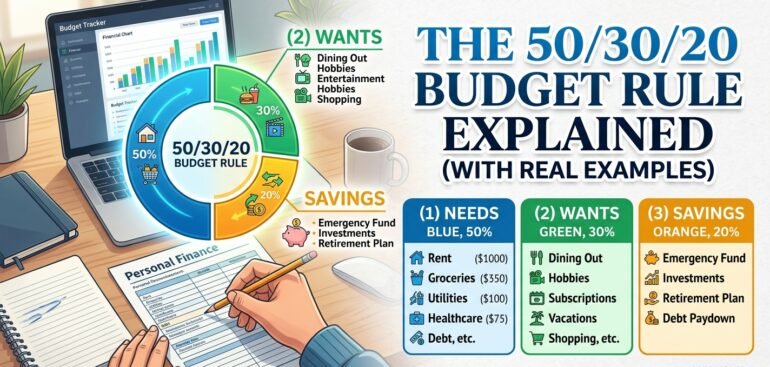
The idea is simple. You allocate approximately 50% of your income toward needs, 30% toward wants, and 20% toward savings and debt repayment. These percentages are guidelines rather than strict requirements, which means you can adjust them according to your income, responsibilities, and financial goals.
In this guide, you will learn how the 50/30/20 budget rule works, how to calculate your own amounts, what counts as a need versus a want, how to use a budget rule calculator, and how to adapt the method when your financial situation does not perfectly fit the standard percentages.
What Is the 50/30/20 Budget Rule?
The 50/30/20 budget rule is a budgeting method that divides your take-home income into three categories:
- 50% for needs
- 30% for wants
- 20% for savings and debt repayment
The purpose of this method is to create balance.
Your essential expenses receive the largest portion of your income because they are necessary for maintaining your basic lifestyle. Your wants receive a separate portion so you can enjoy your money without feeling like every purchase is a financial mistake. The final portion is directed toward your financial future.
For example, if your monthly take-home income is $3,000, the traditional structure would look like this:
| Category | Percentage | Amount |
|---|---|---|
| Needs | 50% | $1,500 |
| Wants | 30% | $900 |
| Savings & Debt | 20% | $600 |
| Total | 100% | $3,000 |
The exact amounts will depend on your income.
How Does the 50/30/20 Budget Rule Work?
The system works by dividing your income before you begin spending it.
Instead of spending first and trying to save whatever remains, you establish your financial priorities in advance.
50% for Needs
The first 50% is intended for essential expenses.
Needs are expenses you generally cannot avoid without affecting your basic living situation or financial responsibilities.
Common examples include:
- Rent or mortgage
- Basic utilities
- Groceries
- Essential transportation
- Insurance
- Required healthcare expenses
- Minimum debt payments
- Basic phone and internet services
- Essential household expenses
The goal is to keep these expenses around half of your take-home income when possible.
However, this can be difficult for people living in areas with high housing or transportation costs. In that situation, the rule should be treated as a framework rather than a strict requirement.
30% for Wants
The next 30% is for things that improve your lifestyle but are not essential.
These expenses are often where needs vs wants budgeting becomes particularly useful.
Examples of wants include:
- Restaurants
- Entertainment
- Streaming services
- Hobbies
- Non-essential shopping
- Vacations
- Upgraded electronics
- Expensive subscriptions
- Leisure activities
Wants are not necessarily bad expenses.
A healthy budget should leave some room for enjoyment. The purpose of the 30% category is to help you enjoy your income while keeping discretionary spending within a reasonable boundary.
20% for Savings and Debt
The final 20% is designed for building your financial future.
This category can include:
- Emergency savings
- Retirement savings
- Long-term investments
- Additional debt payments
- Savings for major purchases
- Other financial goals
If you have high-interest debt, you may choose to direct a significant portion of this category toward reducing that debt.
The important concept is that part of your income should work toward improving your future financial position rather than being spent entirely on current expenses.
Why Is the 50/30/20 Budget Rule Popular?
One reason this budgeting method is popular is its simplicity.
You do not have to create dozens of spending categories before you can start.
Instead, you begin with three broad categories.
This makes the system particularly useful for people who are new to budgeting.
The 50/30/20 budget rule also provides flexibility. You can adjust individual expenses while still keeping the overall framework in mind.
For example, if your needs take up 55% instead of 50%, you might temporarily reduce wants to 25% while continuing to prioritize savings.
The percentages are meant to provide direction, not create unnecessary financial stress.
How to Calculate the 50/30/20 Budget Rule
Calculating your budget is straightforward.
Start with your monthly take-home income.
Then multiply your income by each percentage.
Needs Calculation
Monthly income × 50% = Needs budget
Wants Calculation
Monthly income × 30% = Wants budget
Savings and Debt Calculation
Monthly income × 20% = Savings and debt budget
For example, if your take-home income is $4,000:
Needs:
$4,000 × 0.50 = $2,000
Wants:
$4,000 × 0.30 = $1,200
Savings and debt:
$4,000 × 0.20 = $800
Your target budget would therefore be:
- $2,000 for needs
- $1,200 for wants
- $800 for savings and debt
A budget rule calculator can make these calculations faster, but the underlying formula is simple enough to calculate manually.
50/30/20 Budget Rule Real Example
Let’s consider a person who earns $5,000 per month after taxes.
Using the traditional 50/30/20 structure:
| Category | Percentage | Budget |
|---|---|---|
| Needs | 50% | $2,500 |
| Wants | 30% | $1,500 |
| Savings & Debt | 20% | $1,000 |
Now imagine their actual monthly expenses look like this.
Needs
- Housing: $1,400
- Groceries: $450
- Utilities: $200
- Transportation: $200
- Insurance: $150
- Required payments: $100
Total needs = $2,500
Wants
- Dining out: $300
- Entertainment: $200
- Shopping: $250
- Hobbies: $200
- Subscriptions: $100
- Personal spending: $200
- Travel fund: $250
Total wants = $1,500
Savings and Debt
- Emergency fund: $400
- Long-term savings: $300
- Additional debt payment: $200
- Future purchase fund: $100
Total savings and debt = $1,000
This example follows the 50/30/20 framework exactly.
However, real-life budgets are rarely this perfect. Your percentages may be different, and that is okay.
Needs vs Wants Budgeting Explained
One of the most important parts of the 50/30/20 budget rule is correctly identifying needs and wants.
The difference can sometimes be confusing.
A need is something necessary for your basic living or financial responsibilities.
A want is something you choose because it provides comfort, convenience, entertainment, or enjoyment.
For example, basic groceries are generally a need.
Ordering an expensive meal from a restaurant is generally a want.
Basic transportation needed to get to work may be a need.
Upgrading to a luxury vehicle may be a want.
A basic phone plan may be a need.
Buying the newest smartphone when your current phone works properly may be a want.
Understanding this difference helps you make better spending decisions.
Needs vs Wants: A Simple Test
When you are unsure whether something is a need or a want, ask yourself a few questions.
Can I live without it?
If you could reasonably live without the expense, it may be a want.
Is it required for work or basic living?
If removing the expense would create a serious problem with your basic responsibilities, it may be a need.
Is there a cheaper alternative?
Sometimes the basic service is a need while the upgraded version is a want.
For example, having internet access may be necessary for work, but paying for an expensive premium package may be discretionary.
Did I choose the upgrade?
If the basic option meets your needs and you voluntarily select a more expensive version, the difference may belong in your wants category.
What Counts as a Need?
Needs vary from person to person.
However, common needs include:
Housing
Rent or mortgage payments are generally considered essential expenses.
Food
Basic groceries and essential food expenses are needs.
However, premium food choices, frequent restaurant meals, and delivery may belong in the wants category.
Utilities
Essential electricity, water, heating, and basic communication services generally fall into the needs category.
Transportation
Transportation required for work, education, or essential responsibilities may be considered a need.
Healthcare
Necessary healthcare and required medical expenses are generally needs.
Minimum Debt Payments
Required debt payments should be included among essential financial obligations.
What Counts as a Want?
Wants are expenses that make life more enjoyable but are not essential.
Examples include:
- Entertainment
- Luxury purchases
- Frequent dining out
- Vacations
- Expensive hobbies
- Premium subscriptions
- Designer products
- Non-essential electronics
- Impulse shopping
The goal is not to eliminate these expenses.
Instead, the 30% category gives them a designated place in your budget.
What Happens If Your Needs Are More Than 50%?
This is one of the most important questions about the 50/30/20 budget rule.
Not everyone’s expenses fit perfectly into the traditional percentages.
If your essential expenses take up 60% of your income, forcing them down to 50% immediately may not be realistic.
Instead, look at the bigger picture.
You could temporarily use a structure such as:
- 60% needs
- 20% wants
- 20% savings
Or:
- 60% needs
- 25% wants
- 15% savings
The right balance depends on your situation.
The most important thing is to maintain a sustainable budget rather than following percentages so strictly that you cannot realistically live with the plan.
Can You Use the 50/30/20 Rule With a Low Income?
Yes, but the standard percentages may need adjustment.
When income is limited, essential expenses can consume a larger portion of your budget.
In that situation, focus first on covering necessities.
Then look for realistic ways to reduce flexible expenses and gradually increase savings as your financial situation improves.
Even if you cannot save exactly 20%, saving something consistently can help establish a positive financial habit.
Can You Use the 50/30/20 Rule With an Irregular Income?
Yes.
If your income changes from month to month, start with a conservative estimate.
For example, if your monthly income usually ranges between $2,500 and $4,000, building your essential budget around the lower end can provide more flexibility.
When you earn more than expected, you can allocate the additional income toward savings, debt repayment, upcoming expenses, or other financial goals.
This approach can help prevent you from creating fixed spending commitments based on income that may not arrive every month.
How to Use a Budget Rule Calculator
A budget rule calculator can help you quickly determine your target amounts.
The basic information you need is your monthly take-home income.
For example:
Monthly income: $3,500
50% needs:
$3,500 × 0.50 = $1,750
30% wants:
$3,500 × 0.30 = $1,050
20% savings and debt:
$3,500 × 0.20 = $700
Therefore, your basic target would be:
Needs: $1,750
Wants: $1,050
Savings & Debt: $700
Once you have these numbers, compare them with your actual expenses.
If your needs are $2,000, your budget is already above the 50% target. That does not mean you have failed. It simply shows you where your current spending stands.
How to Adjust the 50/30/20 Rule
The framework can be modified according to your goals.
Suppose you want to save aggressively.
You might use:
- 50% needs
- 20% wants
- 30% savings and debt
If you are temporarily dealing with high essential costs, you might use:
- 60% needs
- 20% wants
- 20% savings
If your income is limited, you may need another arrangement entirely.
The goal is to create a structure that allows you to cover necessities, enjoy your money responsibly, and make progress toward your financial goals.
How to Make the 50/30/20 Rule Work in Real Life
Following a budgeting rule is easier when you turn it into a routine.
Track Your Expenses
Record your spending throughout the month.
This helps you see whether your actual expenses match your plan.
Review Your Budget Weekly
A quick weekly check can prevent small problems from becoming larger ones.
Look at how much you have spent in each category and compare it with your remaining budget.
Automate Savings When Possible
If you can automatically move money toward savings after receiving your income, you may find it easier to stay consistent.
Avoid Impulse Spending
Before making an unplanned purchase, ask whether it is a need or a want.
Then consider whether it fits comfortably within your available wants budget.
Adjust Every Month
Your budget should change when your circumstances change.
A new bill, change in income, major purchase, or financial goal may require adjustments.
Common Mistakes When Using the 50/30/20 Rule
Treating the Percentages as Absolute Rules
The 50/30/20 framework is a guideline.
Do not feel that your budget is unsuccessful simply because your numbers are 55/25/20 or 60/20/20.
Putting Every Food Expense in Needs
Basic groceries may be needs, but frequent restaurant meals and premium food purchases may be wants.
Think about the purpose and necessity of each expense.
Forgetting Irregular Expenses
Annual bills, repairs, gifts, and seasonal expenses can disrupt your budget if you do not plan for them.
Ignoring Debt
Required debt payments should be included in your budget.
Additional debt payments can also be part of your financial goals category.
Giving Up After One Bad Month
A single month of overspending does not mean the system has failed.
Use the experience to understand what needs to change.
Is the 50/30/20 Budget Rule Right for Everyone?
No budgeting method works perfectly for every person.
The 50/30/20 budget rule is useful because it is simple and flexible, but your personal circumstances may require a different structure.
Someone with low housing costs may be able to save more than 20%.
Someone with high essential expenses may need more than 50% for needs.
Someone focused on paying off debt may choose to reduce wants and direct more money toward debt repayment.
The most effective budget is one that reflects your income, responsibilities, priorities, and goals.
How to Start Using the 50/30/20 Budget Rule Today
You can begin with five simple steps.
Step 1: Find Your Take-Home Income
Use the amount you actually receive after deductions.
Step 2: Calculate Your Three Targets
Calculate 50%, 30%, and 20% of your monthly income.
Step 3: List Your Current Expenses
Write down your actual spending rather than estimated spending.
Step 4: Compare Your Numbers
See how your current spending compares with the three target categories.
Step 5: Make Small Adjustments
Do not try to completely change your financial habits overnight.
Start with one or two categories and gradually improve your budget.
Final Thoughts
The 50/30/20 budget rule provides a simple way to organize your money without creating an overly complicated budgeting system.
The basic idea is to direct approximately 50% of your take-home income toward needs, 30% toward wants, and 20% toward savings and debt repayment.
However, your personal situation matters.
If your needs exceed 50%, adjust the percentages. If you can save more than 20%, you may choose to do so. If your income changes, create a flexible plan that can adapt to those changes.
The key is understanding your spending.
By practicing needs vs wants budgeting, tracking your expenses, and reviewing your financial plan regularly, you can make more intentional decisions about where your money goes.
A budget rule calculator can help you quickly determine your target amounts, while a simple monthly review can help you stay on track.
For more practical personal finance guidance, budgeting information, and money-management resources, explore Cash Growth Guide at https://cashgrowthguide.com/.
Remember, a budget is not designed to take away your freedom. It is designed to help you use your money with greater purpose and confidence.
Frequently Asked Questions
What is the 50/30/20 budget rule?
The 50/30/20 budget rule is a budgeting framework that divides take-home income into three categories: approximately 50% for needs, 30% for wants, and 20% for savings and debt repayment.
Is the 50/30/20 budget rule realistic?
It can be realistic for many people, but it is not a strict formula. Your income, housing costs, debt, family responsibilities, and financial goals may require you to adjust the percentages.
What is the 50/30/20 rule on a $3,000 salary?
With $3,000 in monthly take-home income, the traditional calculation would be $1,500 for needs, $900 for wants, and $600 for savings and debt repayment.
What counts as a need in the 50/30/20 rule?
Needs generally include essential housing, basic food, utilities, necessary transportation, insurance, healthcare, and required financial payments.
What counts as a want?
Wants are non-essential expenses such as entertainment, dining out, hobbies, vacations, premium subscriptions, non-essential shopping, and lifestyle upgrades.
Can debt payments be included in the 20% category?
Yes. The 20% category can be used for savings and debt repayment. Required minimum payments may also be considered essential expenses depending on how you structure your budget.
How does a budget rule calculator work?
A budget rule calculator takes your monthly take-home income and applies the selected percentages to determine how much you can target for needs, wants, and savings or debt repayment.
What if my needs are more than 50%?
You do not have to force your expenses into exactly 50%. If your needs are higher, create a modified version of the rule that reflects your circumstances and look for gradual opportunities to improve your financial balance.
Can I change the 50/30/20 percentages?
Yes. The percentages are guidelines. You can modify them according to your financial priorities, income, expenses, and goals.
Is saving 20% of income necessary?
No. Twenty percent is the traditional target of the framework, but your realistic savings amount may be lower or higher. The important thing is to develop a consistent savings habit that fits your situation.
How can needs vs wants budgeting help?
Needs vs wants budgeting helps you identify which expenses are essential and which are discretionary. This can make it easier to control flexible spending without unnecessarily cutting important expenses.
Can beginners use the 50/30/20 budget rule?
Yes. Its simple three-category structure makes it a useful starting point for people who are new to budgeting. You can add more detailed categories once you become comfortable with the basic system.
Should I follow the 50/30/20 rule every month?
You can use it as a monthly budgeting framework, but you should adjust your plan when your income, expenses, or financial goals change.
What is the biggest benefit of the 50/30/20 budget rule?
Its biggest benefit is simplicity. It gives you a straightforward framework for balancing essential expenses, discretionary spending, and financial goals without requiring dozens of complicated categories.