




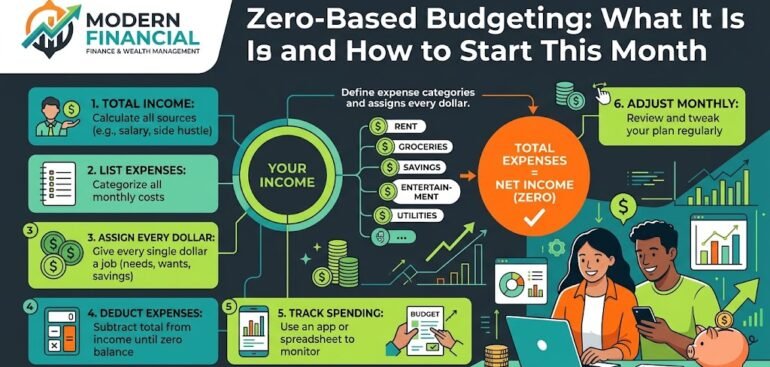
Zero based budgeting offers a different approach. Instead of spending first and reviewing your finances later, you create a plan before the money disappears. Every dollar of your income is assigned to a specific purpose, such as housing, groceries, transportation, savings, debt payments, or personal spending.
Managing money becomes much easier when you know exactly what every dollar is supposed to do. Many people receive their income, pay a few bills, spend on everyday needs, and then wonder where the rest of their money went. Even when income is enough to cover expenses, unplanned spending can make it difficult to save or reach financial goals.
The goal is simple: your income minus all planned allocations should equal zero.
That does not mean you have to spend every dollar. Money assigned to savings, an emergency fund, or debt repayment still has a job. The idea is to make sure there is no money sitting unplanned.
In this beginner-friendly guide, Cash Growth Guide explains what zero-based budgeting is, how it works, how to create your first budget this month, and how to use a zero based budget example to understand the method.
What Is Zero-Based Budgeting?
Zero based budgeting is a budgeting method where you assign your entire income to specific categories until the amount left to assign reaches zero.
The basic formula is:
Monthly Income – Planned Allocations = $0
The important word is “allocations.”
A zero-based budget does not mean your bank account should reach zero. Instead, it means every dollar has already been given a purpose.
For example, imagine you receive $3,000 this month. You could assign that money to:
- Housing
- Utilities
- Groceries
- Transportation
- Insurance
- Debt payments
- Savings
- Emergency fund
- Entertainment
- Personal spending
- Future expenses
If all of these categories together equal $3,000, your budget is zero-based.
There is no unassigned money left.
This approach follows a simple principle: give every dollar a job.
When money has a job before you spend it, you are less likely to spend it simply because it happens to be available in your account.
What Does “Give Every Dollar a Job” Mean?
The idea behind give every dollar a job is straightforward: every dollar you receive should have a purpose.
Suppose you earn $3,000 and your regular expenses total $2,600. You might normally think you have $400 available to spend.
With zero-based budgeting, you decide what that $400 should do before you spend it.
You could assign:
- $150 to your emergency fund
- $100 to debt repayment
- $75 to a future purchase
- $50 to entertainment
- $25 to miscellaneous expenses
Now the entire $3,000 has been assigned.
The $400 did not disappear into random spending. Every part of it received a specific job.
This approach can help you become more intentional with money because you make spending decisions in advance rather than making them impulsively.
How Is Zero-Based Budgeting Different From a Traditional Budget?
A traditional budget may tell you how much you expect to spend in several broad categories.
For example, you might decide to spend:
- $1,000 on housing
- $400 on groceries
- $200 on transportation
- $300 on savings
- $200 on entertainment
But there may still be money left over without a specific purpose.
Zero-based budgeting takes the process further.
Instead of leaving money unassigned, you continue allocating it until every dollar has a job.
The difference is not necessarily how much you earn or spend. The difference is how deliberately you plan the money you already have.
A traditional budget may help you track spending.
A zero-based budget is designed to help you decide where your money should go before you spend it.
Why Does Zero-Based Budgeting Work?
The biggest advantage of zero based budgeting is awareness.
When every dollar is assigned, you have a clearer picture of your financial priorities.
You know what money is available for groceries.
You know how much is reserved for bills.
You know how much is going toward savings.
You know how much can be used for flexible spending.
This can reduce the uncertainty that often comes with managing money.
It Helps Control Unplanned Spending
Unplanned spending can happen when money appears to be available.
If your bank account shows $700, you may feel comfortable spending $100 on something you want. But that $700 may actually need to cover groceries, utilities, transportation, and upcoming bills.
A zero-based budget gives those dollars specific jobs.
Instead of seeing $700 as available money, you see it as money already assigned to different responsibilities.
It Makes Savings More Intentional
Saving whatever remains at the end of the month can be difficult.
If savings is not included in your plan, other expenses can easily consume the available money.
Zero-based budgeting allows you to assign money to savings before discretionary spending takes over.
It Helps With Debt Repayment
Debt payments can also receive a specific job in your budget.
You can include required payments as well as additional payments when your finances allow.
This makes debt reduction part of your overall financial plan rather than something you handle only when extra money happens to be available.
How to Start Zero-Based Budgeting This Month
Starting a new budgeting system does not need to be complicated.
You can create your first zero-based budget using the following steps.
Step 1: Calculate Your Monthly Income
Start by determining how much money you expect to have available during the month.
If your income is fixed, this may be easy.
If your income changes, use a conservative estimate based on what you can reasonably expect.
Include reliable sources such as:
- Salary
- Freelance income
- Business income
- Part-time income
- Commissions
- Other predictable income
Use your take-home income rather than an amount you will not actually receive.
The goal is to build your budget around money that is genuinely available.
Step 2: List Your Fixed Expenses
Next, write down expenses that are relatively predictable.
These may include:
- Rent or mortgage
- Insurance
- Loan payments
- Phone bills
- Internet
- Subscription services
- School or education payments
- Other recurring bills
Fixed expenses should be included before flexible spending because they usually have specific due dates and requirements.
Step 3: List Your Variable Expenses
Variable expenses can change from month to month.
Examples include:
- Groceries
- Electricity
- Fuel
- Transportation
- Dining out
- Entertainment
- Shopping
- Personal care
- Household items
Review your previous spending if possible.
This gives you a more realistic starting point than simply guessing how much you spend.
Step 4: Add Savings Goals
Savings should be treated as an actual category.
You might create separate categories for:
- Emergency savings
- Short-term savings
- Future purchases
- Education
- Travel
- Retirement
- Other financial goals
The amount you save will depend on your income, expenses, debt, and priorities.
The key is to assign an amount that is realistic enough to maintain consistently.
Step 5: Include Debt Payments
If you have debt, include it in your zero-based budget.
Start with required payments.
Then determine whether you can allocate additional money toward debt reduction.
For example, if your required debt payments are $250 and you decide to make an additional $100 payment, your budget should reflect the full $350 allocation.
This gives your debt a clear place in your financial plan.
Step 6: Plan for Irregular Expenses
Some expenses do not happen every month.
Examples include:
- Annual insurance
- Vehicle maintenance
- Gifts
- School expenses
- Home repairs
- Medical costs
- Seasonal expenses
- Annual memberships
These expenses can cause problems when they are ignored.
Instead, estimate the annual cost and divide it into monthly amounts.
For example, if you expect to spend $600 on a particular annual expense:
$600 ÷ 12 = $50 per month
You can then assign $50 each month toward that future expense.
This makes large occasional costs easier to manage.
Step 7: Add Flexible Spending
A zero-based budget does not mean you cannot enjoy your money.
You can create categories for things you enjoy, such as:
- Dining out
- Entertainment
- Hobbies
- Shopping
- Personal spending
- Social activities
The purpose is not to eliminate fun.
The purpose is to decide how much you can comfortably spend without interfering with your important financial responsibilities.
Step 8: Assign Every Dollar
Now comes the most important step.
Take your total monthly income and start assigning it to your categories.
For example:
Income: $3,500
You might assign:
- Housing: $1,000
- Utilities: $250
- Groceries: $450
- Transportation: $250
- Insurance: $200
- Debt: $300
- Savings: $400
- Personal spending: $200
- Entertainment: $150
- Future expenses: $150
- Miscellaneous: $150
Total allocations:
$3,500
Money remaining to assign:
$0
That is a zero-based budget.
Zero Based Budget Example
A practical zero based budget example can make the concept easier to understand.
Imagine a person earns $4,000 per month after taxes.
Their monthly plan could look like this:
| Category | Planned Amount |
| Housing | $1,200 |
| Utilities | $250 |
| Groceries | $450 |
| Transportation | $250 |
| Insurance | $200 |
| Debt Payments | $300 |
| Emergency Fund | $400 |
| Long-Term Savings | $300 |
| Personal Spending | $200 |
| Entertainment | $150 |
| Irregular Expenses | $150 |
| Miscellaneous | $150 |
| Total | $4,000 |
In this example, the full $4,000 has been assigned.
There is no money left without a purpose.
Notice that savings and debt payments are included in the allocations. This is why zero-based budgeting does not mean spending everything.
Some money is being spent, some is being saved, and some is being used to improve the person’s financial position.
What If You Have Money Left Over?
If you finish your initial budget and still have money left over, do not automatically spend it.
Ask yourself what that money could accomplish.
You could assign it toward:
- Emergency savings
- Debt repayment
- A future purchase
- Retirement savings
- Annual expenses
- A financial goal
- A reasonable amount of personal spending
For example, if your income is $3,500 and your initial allocations total $3,300, you still have $200 to assign.
You could divide it between savings and debt repayment.
The goal is not to find ways to spend the remaining money.
The goal is to give it a meaningful purpose.
What If Your Budget Is More Than Your Income?
This is where budgeting becomes especially useful.
Suppose your monthly income is $3,000 but your planned expenses total $3,400.
You have a $400 gap.
Instead of ignoring it, review your categories.
Start by looking at flexible expenses.
Could you reduce:
- Dining out?
- Entertainment?
- Shopping?
- Subscriptions?
- Personal spending?
- Non-essential purchases?
If your essential expenses are already very high, cutting small expenses may not be enough.
In that situation, you may also need to consider ways to increase income or reduce larger recurring costs.
The purpose of zero-based budgeting is to make the problem visible so you can make informed decisions.
How to Handle Unexpected Expenses
Even a carefully planned budget cannot predict everything.
Your car may need a repair.
A medical expense may appear.
A household item may need to be replaced.
When an unexpected expense occurs, do not assume your entire budget has failed.
Instead, adjust your allocations.
For example, suppose you have $150 available in your entertainment category but need $100 for an unexpected repair.
You could move $100 from entertainment toward the repair.
Now the repair has been funded without increasing your total budget.
This flexibility is important.
A zero-based budget is a plan, not a prison.
Zero-Based Budgeting With Irregular Income
People with variable income may find budgeting more challenging because the exact amount available can change each month.
If your income is inconsistent, avoid building your plan around your best month.
Instead, use a realistic conservative estimate.
For example, if your monthly income usually ranges between $2,500 and $3,500, you might create your essential plan around the lower end.
When you earn more than expected, you can assign the additional money toward:
- Emergency savings
- Debt repayment
- Future expenses
- Long-term goals
- Other priorities
This approach can make variable income easier to manage because you are not depending on an unusually strong month to cover essential expenses.
How to Make Zero-Based Budgeting Easier
A budgeting system should help your financial life, not make it unnecessarily stressful.
Here are several ways to make the process easier.
Keep Your Categories Simple
You do not need dozens of categories when you are starting.
Begin with major areas such as:
- Housing
- Utilities
- Food
- Transportation
- Debt
- Savings
- Personal spending
- Entertainment
- Miscellaneous
You can create additional categories later if needed.
Review Your Budget Weekly
Do not wait until the end of the month to see whether your plan worked.
Spend a few minutes each week reviewing your spending.
Ask:
- How much have I spent?
- Which categories are getting close to their limits?
- Do I need to adjust anything?
- Are upcoming expenses properly funded?
Regular reviews make it easier to make small adjustments before they become larger problems.
Give Savings a Specific Purpose
Instead of having one general savings category, you can create separate goals.
For example:
Emergency Fund: $200
Future Purchase: $100
Annual Expenses: $100
Specific goals can make saving feel more meaningful.
Leave Room for Real Life
A budget that has no flexibility can be difficult to maintain.
Include a reasonable miscellaneous category for expenses that do not fit neatly into your other categories.
This can help prevent one unexpected purchase from disrupting the entire month.
Common Zero-Based Budgeting Mistakes
Even a simple system can become difficult if you make a few common mistakes.
Mistake 1: Thinking Zero Means Spend Everything
Zero does not mean an empty bank account.
It means zero money remains unassigned.
Savings and debt payments are both valid jobs for your money.
Mistake 2: Forgetting Irregular Expenses
Annual and seasonal expenses should not be ignored.
Plan for them before they arrive.
Mistake 3: Making the Budget Too Strict
If your budget does not allow any reasonable personal spending, you may find it difficult to maintain.
Build flexibility into your plan.
Mistake 4: Using Unrealistic Numbers
If you normally spend $400 on groceries, setting a $150 grocery limit without a realistic plan for reducing costs may cause frustration.
Use actual spending data as your starting point.
Mistake 5: Never Adjusting the Budget
Your budget should change when your circumstances change.
Income may increase or decrease.
Bills may change.
Financial goals may change.
Adjust your allocations when necessary.
Is Zero-Based Budgeting Right for You?
Zero based budgeting can be especially useful if you want greater control over your money.
It may be a good fit if:
- You frequently wonder where your money went.
- You want to increase savings.
- You are working toward debt reduction.
- Your spending needs more structure.
- You want every dollar to have a clear purpose.
- You are working toward specific financial goals.
However, you do not have to make your budget extremely detailed.
If a simpler system helps you stay consistent, start there and gradually add more detail.
The best budgeting method is one you can actually maintain.
How to Start Your Zero-Based Budget Today
You do not need to wait until the beginning of next year or even the beginning of next month.
You can start today.
Write down your expected income.
Then list your essential expenses.
Add debt payments.
Add savings goals.
Add flexible spending.
Plan for irregular expenses.
Finally, assign every remaining dollar until the amount left to assign reaches zero.
Your first budget may not be perfect.
That is okay.
The first month is an opportunity to learn how your money actually behaves.
After reviewing your spending, you can make better decisions for the following month.
Zero-Based Budgeting vs. Simply Tracking Expenses
Tracking expenses tells you what happened.
Zero-based budgeting helps you decide what should happen.
For example, expense tracking might show that you spent $500 on dining out last month.
A zero-based budget allows you to decide before the month starts that dining out will have a $200 allocation.
This creates a spending boundary before the money is gone.
Tracking is still useful, but planning gives your spending more direction.
Using both together can create a stronger financial routine.
Build a Budget That Supports Your Goals
The purpose of budgeting is not simply to create restrictions.
Your budget should support the life you want to build.
If your goal is financial security, your budget can prioritize emergency savings.
If your goal is debt reduction, you can assign more money toward debt.
If you are saving for a major purchase, you can create a dedicated category.
If you want more freedom with your money, you can intentionally create flexible spending categories.
Every dollar should support something that matters to you.
That is the real power behind the principle give every dollar a job.
Frequently Asked Questions
What is zero-based budgeting?
Zero-based budgeting is a method where you assign all of your monthly income to specific categories until the amount left to assign reaches zero. The money can go toward bills, savings, debt payments, future expenses, or personal spending.
Does zero-based budgeting mean spending all your money?
No. Zero-based budgeting does not mean your bank account should reach zero. It means every dollar has been assigned a purpose. Money allocated to savings or debt repayment has a job even though it has not been spent.
What does “give every dollar a job” mean?
“Give every dollar a job” means deciding what each dollar of your income should accomplish before you spend it. A dollar might pay a bill, buy groceries, build savings, reduce debt, or fund a future expense.
How do I start zero-based budgeting?
Start by calculating your monthly income, listing your expenses, adding savings and debt goals, planning for irregular expenses, and assigning the remaining money to specific categories until your amount left to assign reaches zero.
Can zero-based budgeting work with irregular income?
Yes. If your income changes from month to month, use a conservative estimate for essential planning. When you receive more income than expected, assign the additional money to savings, debt, future expenses, or other financial priorities.
What is a zero based budget example?
A zero based budget example could be a person earning $4,000 and assigning the full amount to housing, utilities, groceries, transportation, debt payments, savings, personal spending, entertainment, and future expenses. When all allocations total $4,000, the amount left to assign is zero.
Is zero-based budgeting difficult for beginners?
It may take some time to get used to because you need to think about each category. However, beginners can start with a small number of categories and make the system more detailed over time.
What should I do if I overspend in one category?
Review your remaining categories and move money from a lower-priority category if possible. For example, if groceries cost more than expected, you might temporarily reduce entertainment or another flexible category.
Should savings be included in zero-based budgeting?
Yes. Savings should be treated as one of your planned allocations. You can create categories for emergency savings, future purchases, annual expenses, retirement, or other financial goals.
Can I change my zero-based budget during the month?
Yes. Your budget should be flexible enough to respond to real-life changes. If one category needs more money, you can move funds from another category as long as your overall plan remains balanced.
Final Thoughts
Zero based budgeting gives you a simple but powerful way to take control of your money. Instead of allowing income to disappear through unplanned spending, you decide where your money should go before the month gets busy.
The basic process is straightforward: calculate your income, list your expenses, plan for savings and debt, prepare for irregular costs, and assign every dollar until nothing remains unassigned.
Remember that zero-based budgeting does not mean spending everything. It means making sure every dollar has a purpose.
Your first budget does not have to be perfect. Start with realistic numbers, track your actual spending, review your progress, and make adjustments as you learn more about your financial habits.
At Cash Growth Guide, the goal is to make personal finance easier to understand and easier to apply. A practical budget can help you make better decisions today while creating a stronger foundation for your future financial goals.