




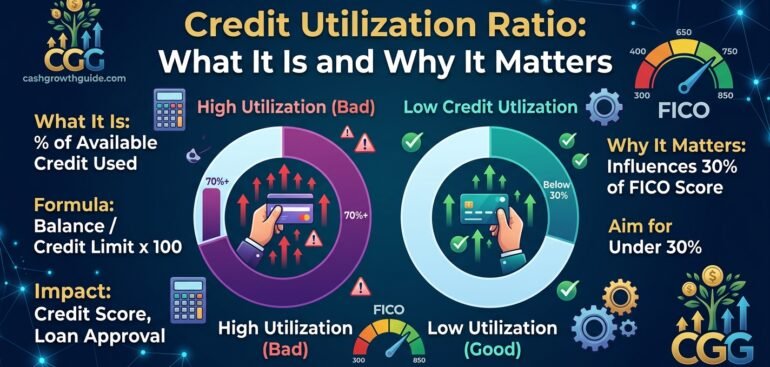
Your credit card balance can affect more than your monthly budget. It can also influence how lenders view your credit profile. One of the important measurements to understand is the credit utilization ratio.
Credit utilization shows how much of your available revolving credit you are currently using. If you have credit cards or other revolving accounts, understanding this ratio can help you manage balances more effectively and make informed financial decisions.
A lower utilization level is generally viewed more favorably by many credit scoring models. However, credit utilization is only one part of your overall credit profile. Payment history, credit history, new applications, and other factors can also matter.
At Cash Growth Guide, understanding everyday financial concepts can help you make better money decisions. This guide explains how credit utilization works, how to calculate it, what ideal credit utilization can look like, and how to manage your balances responsibly.
What Is a Credit Utilization Ratio?
The credit utilization ratio measures the percentage of your available revolving credit that you are using.
For example, suppose you have a total credit limit of $5,000 across your credit cards and your current balances add up to $1,000. Your credit utilization would be 20%.
The basic calculation is:
Credit Utilization Ratio = Total Credit Card Balances ÷ Total Credit Limits × 100
This calculation can be considered for an individual credit card as well as across multiple revolving accounts.
For example, if one card has a $2,000 limit and a $400 balance, the utilization for that card is 20%.
The ratio becomes useful because it puts your balance into context. A $500 balance may seem relatively small, but its impact can look different depending on whether your credit limit is $1,000 or $10,000.
Why Does Credit Utilization Matter?
Credit utilization matters because it can be one of the factors considered by credit scoring systems.
A high utilization ratio may indicate that you are relying heavily on available revolving credit. A lower ratio can show that a smaller portion of your available credit is being used.
However, utilization should not be viewed in isolation. A person with low utilization can still have credit problems if they frequently miss payments or have other negative information in their credit history.
Likewise, someone with a temporary increase in utilization may not necessarily have a long-term credit problem.
The goal is to understand the relationship between your credit limits and balances so you can manage your credit more carefully.
How to Calculate Credit Utilization Ratio
Calculating your credit utilization ratio is simple.
First, add together the balances on your revolving credit accounts. Next, add together the credit limits on those accounts. Finally, divide the total balances by the total limits and multiply the result by 100.
For example:
Imagine you have three credit cards:
- Card A: $500 balance with a $2,000 limit
- Card B: $700 balance with a $3,000 limit
- Card C: $300 balance with a $5,000 limit
Your total balance is $1,500.
Your total credit limit is $10,000.
The calculation would be:
$1,500 ÷ $10,000 × 100 = 15%
Your overall credit utilization ratio would therefore be 15%.
This calculation can give you a quick snapshot of how much of your available revolving credit you are using.
What Is Ideal Credit Utilization?
There is no single percentage that guarantees a particular credit score. Credit scoring models can use different calculations and may consider information at different points in time.
Still, keeping utilization relatively low is a common credit-management strategy.
The concept of ideal credit utilization is often discussed because lower utilization may be viewed more positively than very high utilization. The important point is not to treat one percentage as a guaranteed scoring target.
For example, moving from 80% utilization to 30% can represent a meaningful reduction in revolving debt usage. Moving from 30% to 10% may also change the ratio, but the exact effect on a credit score can vary.
Instead of chasing a perfect number, focus on maintaining manageable balances and avoiding unnecessary dependence on available credit.
Individual Credit Card Utilization vs Overall Utilization
There are two utilization measurements you should understand.
The first is individual-card utilization. This looks at the balance and limit of a single credit card.
The second is overall utilization. This looks at your balances and limits across multiple revolving accounts.
For example, imagine you have two cards.
Card A has a $900 balance and a $1,000 limit. Card B has a $100 balance and a $4,000 limit.
Your overall utilization may appear relatively moderate when both cards are considered together. However, Card A itself is using a very high percentage of its available limit.
This is why looking only at your total utilization may not give you the complete picture.
Credit Utilization Calculator: How It Works
A credit utilization calculator can make the calculation faster.
You do not need a complicated formula. You simply need your current revolving balances and corresponding credit limits.
For a single account, enter:
Current Balance: $600
Credit Limit: $2,000
Then calculate:
$600 ÷ $2,000 × 100 = 30%
For multiple accounts, add the balances first and then add the credit limits.
For example:
Total balances: $2,000
Total limits: $10,000
Then:
$2,000 ÷ $10,000 × 100 = 20%
You can also perform the calculation manually using the formula above. The purpose of a credit utilization calculator is simply to make the process quicker and easier.
What Happens When Credit Utilization Is High?
High utilization means you are using a large percentage of your available revolving credit.
For example, if your credit limit is $4,000 and your balance is $3,600, your utilization is 90%.
A high ratio can be a warning sign that your available credit is becoming heavily used. It may also make your monthly payments harder to manage, especially if the balance continues to grow.
High utilization can also become expensive when interest charges accumulate.
The bigger concern is often not the percentage itself but the financial behavior behind it. If you repeatedly need most of your available credit to cover normal expenses, it may be useful to review your budget and spending patterns.
What Happens When Credit Utilization Is Low?
Low utilization means you are using a smaller portion of your available revolving credit.
For example, a $200 balance on a $5,000 credit limit represents 4% utilization.
Low utilization can provide more available credit for unexpected expenses. It can also reduce the risk of reaching your credit limit.
However, low utilization does not automatically mean your overall credit profile is strong.
You still need to pay bills on time, monitor your accounts, manage debt responsibly, and avoid unnecessary credit applications.
Credit management works best when utilization is treated as one part of a broader financial strategy.
Does Paying Your Credit Card in Full Help?
Paying your credit card balance in full can help you avoid carrying revolving debt from month to month and may reduce interest costs.
It can also help keep your balance under control.
However, your reported balance and your payment date are not necessarily the same thing. Credit information can be reported based on account activity at particular points in the billing cycle.
As a result, someone who pays the full balance each month could still have a balance reported at a particular time.
This is why understanding both your spending habits and reporting timing can be useful.
The main objective should be responsible repayment rather than trying to manipulate a particular number.
How to Lower Your Credit Utilization Ratio
If your utilization is higher than you want, there are several practical approaches you can consider.
Pay Down Existing Credit Card Balances
One of the most direct ways to reduce utilization is to reduce your revolving balances.
Start by reviewing the balances on each account. Then create a realistic repayment plan based on your income, essential expenses, and other financial obligations.
Even consistent payments can gradually reduce your outstanding balance.
Avoid Adding New Unnecessary Charges
Paying down a balance becomes harder if you continue adding new purchases to the same account.
Before using a credit card, consider whether the purchase fits within your current budget.
Credit cards can be useful financial tools, but they should not become a substitute for income.
Make Payments Before Balances Become Difficult to Manage
Waiting until a balance becomes very large can make repayment more stressful.
Regular payments can help you maintain better control over your revolving debt.
If your budget allows, you may choose to make payments throughout the billing cycle rather than relying only on one large payment.
Focus on High-Utilization Accounts
If you have several credit cards, identify the accounts that are using the largest percentage of their individual limits.
Reducing a card that is close to its limit can lower that card’s individual utilization.
At the same time, continue monitoring your overall debt so that your repayment strategy remains manageable.
Avoid Unnecessary Credit Limit Increases
A higher credit limit can reduce your utilization ratio if your balance stays unchanged. However, requesting additional credit should not be used as an excuse to spend more.
The important part is controlling the balance.
For example, increasing your limit from $5,000 to $8,000 does not solve a debt problem if your spending increases along with the limit.
Credit availability should support responsible financial management, not encourage additional borrowing.
Does Closing a Credit Card Affect Utilization?
Closing a credit card can change your available credit.
Suppose you have two cards with combined limits of $10,000 and balances of $2,000. Your overall utilization is 20%.
If you close an unused card with a $4,000 limit while keeping the same $2,000 balance, your available credit could fall to $6,000.
Your utilization would then become:
$2,000 ÷ $6,000 × 100 = 33.3%
This example shows why closing an account can change your utilization even when your balance has not changed.
Before closing an account, consider how its credit limit affects your overall profile and whether the account has other financial implications.
Can You Raise Your Credit Score Fast by Lowering Utilization?
People often search for ways to raise credit score fast, especially before applying for financing.
Reducing high credit utilization may help because utilization is one factor that can be considered in credit scoring. However, there is no universal shortcut that guarantees a specific score increase within a specific period.
Your credit score can depend on multiple pieces of information.
If your utilization is very high, paying down balances may improve the credit profile once the lower balances are reflected in the relevant credit information.
Still, it is better to focus on sustainable habits than temporary changes made only to achieve a short-term result.
Does Carrying a Credit Card Balance Improve Your Credit?
Carrying a balance does not automatically make your credit stronger.
You do not need to maintain credit card debt simply to demonstrate credit activity.
In fact, carrying unnecessary balances can result in interest charges and make debt harder to manage.
Responsible credit use is more important than intentionally paying interest. Use credit within your financial means and make payments according to your repayment plan.
Credit Utilization and Your Monthly Budget
Credit utilization is closely connected to budgeting.
If your credit card balance increases every month because your expenses are greater than your available income, lowering utilization may require more than making an occasional payment.
You may need to review your monthly spending.
Start by separating essential expenses from discretionary purchases. Then identify areas where spending can be reduced.
Once your budget becomes more realistic, you can direct additional money toward outstanding credit card balances.
This approach addresses the underlying financial behavior instead of focusing only on the utilization percentage.
How Credit Limits Affect Utilization
Your credit limit directly affects the utilization calculation.
Consider two people with identical $1,000 balances.
Person A has a $2,000 credit limit.
Person B has a $10,000 credit limit.
Person A has 50% utilization, while Person B has 10%.
The balance is exactly the same, but the utilization ratio is different because the available credit is different.
This is why understanding the ratio is more useful than looking at the balance alone.
However, a larger credit limit should never be treated as permission to increase spending.
Common Credit Utilization Mistakes
Many people make avoidable mistakes when managing revolving credit.
One common mistake is looking only at the total balance without considering the credit limit.
Another is assuming that carrying a balance automatically improves credit. It does not.
Some people also close old accounts without considering how the lost credit limit could affect their utilization.
Another mistake is making large purchases simply because enough credit is available.
Finally, some people focus heavily on utilization while ignoring payment history and other important aspects of credit management.
A balanced approach is usually more practical.
How Often Should You Check Your Credit Utilization?
You can check your credit utilization whenever you review your credit card balances and limits.
Monthly monitoring can be especially useful because it fits naturally into a regular financial routine.
You do not need to obsess over daily changes.
Instead, make credit review part of your broader money-management process. Check your balances, review upcoming payments, compare spending with your budget, and identify accounts that may require attention.
A consistent routine can help you spot problems before they become difficult to manage.
A Simple Strategy for Managing Credit Utilization
You can create a simple monthly credit-management routine.
Start by recording the balance and credit limit for each revolving account.
Next, calculate your individual utilization ratios and your overall ratio.
Then review your monthly budget and determine how much you can realistically put toward existing balances.
Avoid unnecessary purchases that could increase revolving debt.
Finally, continue making payments on time and review your progress regularly.
The goal is not to achieve a perfect utilization percentage overnight. The goal is to build habits that keep revolving debt manageable.
Credit Utilization vs Credit Score
Credit utilization and credit score are not the same thing.
Your utilization ratio is a measurement of revolving credit usage. Your credit score is a broader numerical assessment calculated using information from your credit history and other relevant data.
This distinction is important.
A low utilization ratio does not guarantee an excellent credit score. Similarly, a person may have a good credit profile while experiencing temporary changes in utilization.
Think of utilization as one piece of the larger credit picture.
Understanding this difference can prevent unrealistic expectations and help you focus on the financial habits you can control.
Final Thoughts on Credit Utilization Ratio
The credit utilization ratio is an important concept for anyone who uses revolving credit.
It shows how much of your available credit you are using and can help you understand how your balances relate to your credit limits.
Keeping utilization manageable, paying bills on time, avoiding unnecessary debt, and maintaining a realistic budget can all support responsible credit management.
Instead of focusing on a single magic percentage, pay attention to your overall financial behavior. Use a credit utilization calculator when you want a quick calculation, monitor individual and overall utilization, and make repayment decisions that fit your budget.
For more practical personal finance guidance, visit Cash Growth Guide and continue building a stronger understanding of budgeting, saving, debt management, and everyday money decisions.
Frequently Asked Questions
What is a credit utilization ratio?
A credit utilization ratio is the percentage of your available revolving credit that you are currently using. It is calculated by dividing your total revolving credit balances by your total credit limits and multiplying the result by 100.
What is considered ideal credit utilization?
There is no single utilization percentage that guarantees a specific credit score. Lower utilization is generally preferable to very high utilization, but credit scoring also considers other aspects of your credit profile.
How do I calculate my credit utilization?
Add your revolving credit balances, add your credit limits, divide total balances by total limits, and multiply by 100.
For example, $1,000 in balances divided by $5,000 in available credit equals 20% utilization.
Can a credit utilization calculator calculate multiple cards?
Yes. You can use the same basic formula for multiple cards by adding all balances together and all credit limits together before calculating the percentage.
Does high credit utilization hurt your credit score?
High utilization can negatively affect credit scores in some scoring models. The exact impact can vary depending on the scoring model and the rest of your credit profile.
Can I raise my credit score fast by paying down credit cards?
Reducing high revolving balances may help your credit profile once the updated information is reflected. However, there is no guaranteed timeframe or universal amount by which your score will increase.
Does paying my credit card in full help?
Paying the full balance can help you avoid carrying unnecessary revolving debt and interest charges. It can also help you maintain lower balances when managed consistently.
Should I keep a small balance on my credit card?
You do not need to carry a balance simply to build credit. Carrying unnecessary debt can create interest costs and make your finances harder to manage.
Does closing a credit card change utilization?
It can. Closing an account may reduce your total available credit. If your balances remain unchanged, your overall utilization ratio can increase.
Is credit utilization the only credit score factor?
No. Credit scoring can consider several types of information. Payment history, length of credit history, credit accounts, new applications, and other factors may also play a role.
How often should I calculate my credit utilization?
Checking it monthly can be a practical habit. You can calculate it whenever you review your credit card balances, limits, and monthly budget.
Can increasing my credit limit lower utilization?
If your balance remains unchanged, a higher credit limit can mathematically reduce your utilization ratio. However, increasing available credit should not lead to unnecessary spending or additional debt.