




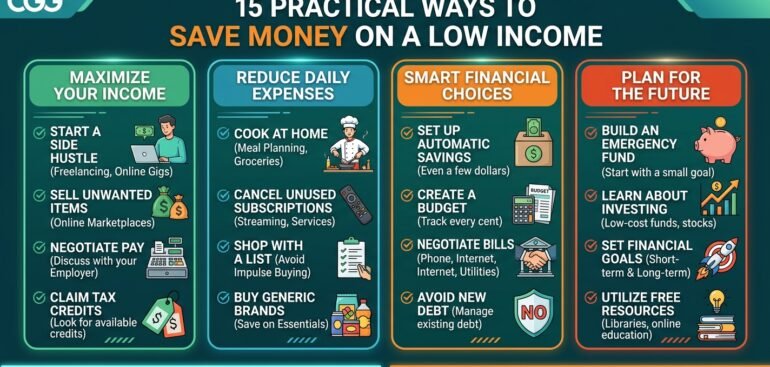
Saving money can feel difficult when your income is limited. After paying rent, utilities, groceries, transportation, debt payments, and other necessary expenses, there may seem to be little or nothing left to save.
But having a low income does not mean saving money is impossible.
The key is to focus on realistic changes that fit your current financial situation. You do not need to completely change your lifestyle or save a huge amount every month. Small amounts saved consistently can create a useful financial cushion over time.
Learning how to save money on a low income starts with understanding where your money goes, identifying expenses you can control, and creating a simple system that you can actually maintain.
In this guide, Cash Growth Guide explains 15 practical ways to reduce unnecessary spending, save more from a limited income, and make progress even when you are living paycheck to paycheck.
Why Saving Money on a Low Income Feels Difficult
Before discussing specific strategies, it is important to understand why saving can be challenging when your income is limited.
Many people have fixed expenses that consume a large percentage of their monthly income. Housing, food, transportation, utilities, healthcare, and debt payments are often difficult to reduce quickly.
This means telling someone to “just spend less” is not always helpful.
Instead, the goal should be to identify realistic opportunities to improve your financial situation without creating an unrealistic budget.
You may start by saving a small amount, reducing one unnecessary expense, or finding a way to increase your income.
The most important thing is to make progress without creating a financial plan that you cannot follow.
How to Save Money on a Low Income
There is no single trick that will suddenly create hundreds of dollars in savings.
Instead, saving money usually comes from several small improvements working together.
The following 15 strategies can help you build better money habits and create room for savings.
1. Create a Simple Monthly Budget
The first step in learning how to save money on a low income is understanding exactly where your income goes.
A budget gives your money a purpose before you spend it.
Start by writing down your monthly income and then list your expenses.
Include:
- Rent or mortgage
- Utilities
- Groceries
- Transportation
- Insurance
- Debt payments
- Healthcare
- Phone and internet
- Personal expenses
- Entertainment
- Savings
Once everything is written down, compare your total expenses with your income.
This can reveal areas where your spending may be higher than expected.
A budget does not mean you cannot spend money on things you enjoy. It simply helps you decide how much you can realistically afford.
If you need help organizing your monthly finances, Cash Growth Guide provides practical personal finance guidance to help you build a clearer money-management routine.
2. Track Every Expense for 30 Days
If you are not sure where your money is going, track every expense for one month.
Write down even small purchases.
A $3 coffee may not seem important, but repeated small purchases can become a noticeable monthly expense.
Track:
- Groceries
- Snacks
- Transportation
- Online purchases
- Subscriptions
- Dining out
- Entertainment
- Personal spending
- Bills
- Other purchases
After 30 days, review your spending.
Look for patterns.
You may discover that certain expenses are consuming more money than you realized.
Once you know where your money is going, you can make better decisions about where to reduce spending.
3. Separate Needs From Wants
One of the most useful frugal living tips is learning the difference between needs and wants.
Needs are expenses required for your basic lifestyle and responsibilities.
Examples include:
- Housing
- Basic food
- Essential utilities
- Necessary transportation
- Healthcare
- Required debt payments
Wants are expenses that can improve your lifestyle but are not essential.
Examples include:
- Restaurant meals
- Entertainment
- New clothes when existing clothes are sufficient
- Premium subscriptions
- Expensive hobbies
- Non-essential upgrades
This does not mean you should eliminate every want.
Instead, ask yourself whether a purchase is necessary before spending the money.
If your income is limited, prioritizing needs can create more room for savings.
4. Reduce Grocery Costs
Food is an essential expense, but there may still be ways to reduce your grocery bill.
Start by planning your meals before shopping.
Create a shopping list based on meals you actually intend to prepare.
Avoid buying large quantities of items simply because they appear inexpensive.
You can also:
- Compare prices
- Use ingredients across multiple meals
- Cook larger portions
- Reduce food waste
- Use leftovers
- Buy only what you need
- Plan meals around ingredients already at home
Small changes in grocery spending can make a meaningful difference over several months.
If you save even $30 each month, that becomes $360 over a year.
5. Cut Unused Subscriptions
Subscriptions can quietly reduce your available income.
Review recurring charges for:
- Streaming services
- Apps
- Fitness memberships
- Software
- Online services
- Subscription boxes
- Other recurring memberships
Ask yourself how frequently you actually use each service.
If you are paying for something you rarely use, canceling it can create an immediate monthly saving.
You do not need to cancel everything.
Focus on subscriptions that provide little value compared with their cost.
6. Use a “No-Spend” Period
A short no-spend period can help you become more aware of unnecessary purchases.
During a no-spend week, avoid non-essential purchases.
Continue paying for necessary expenses such as housing, utilities, groceries, transportation, and healthcare.
The purpose is not punishment.
It is awareness.
You may discover how often you normally spend money simply because something is convenient or appealing.
After the week ends, identify which purchases you can reduce permanently.
You can repeat a no-spend week occasionally when you need to reset your spending habits.
7. Save Money Automatically
Saving becomes easier when you do not have to make the same decision every month.
If possible, set up an automatic transfer into your savings account after receiving your income.
The amount does not have to be large.
For example:
$25 per month = $300 per year
$50 per month = $600 per year
$100 per month = $1,200 per year
The exact amount depends on your financial situation.
The goal is to create consistency.
Even if you start with $10 or $20, establishing the habit can be more important than the initial amount.
8. Build a Small Emergency Fund
Unexpected expenses can make saving difficult.
A vehicle repair, medical bill, urgent home expense, or temporary loss of income can quickly consume your available money.
This is why building an emergency fund should be one of your financial priorities.
You do not need to start with a huge target.
Begin with a small amount that feels achievable.
For example:
First goal: $100
Then:
$250 → $500 → $1,000 → larger emergency fund
The appropriate long-term target depends on your essential monthly expenses and financial circumstances.
The important thing is to start creating a financial cushion.
9. Reduce Transportation Costs
Transportation can take a significant portion of a limited income.
Review how much you spend on:
- Fuel
- Public transportation
- Parking
- Vehicle maintenance
- Insurance
- Ride services
- Vehicle payments
Look for realistic ways to reduce these expenses.
Depending on your circumstances, you might combine errands into fewer trips, use public transportation when practical, carpool, walk for short distances, or reduce unnecessary driving.
Even small reductions in transportation costs can create additional money for savings.
10. Cook More Meals at Home
Eating out and ordering food can become expensive when repeated frequently.
Cooking at home gives you more control over your food budget.
You do not need to prepare complicated meals.
Simple meals using affordable ingredients can be enough.
Try planning several meals at the beginning of the week and preparing extra portions for later.
If you normally spend $10 on a meal outside the home several times each week, replacing some of those meals with home-cooked alternatives can create noticeable savings.
You can still enjoy eating out occasionally.
The goal is to make it an intentional expense rather than an automatic habit.
11. Use the 24-Hour Rule Before Buying
Impulse purchases can be particularly harmful when you are trying to save money.
One simple strategy is to wait 24 hours before buying something that is not essential.
Ask yourself:
- Do I really need it?
- Do I already own something similar?
- Can I afford it without affecting my savings?
- Will I still want it tomorrow?
- Does it support my current financial goals?
Sometimes the desire disappears after waiting.
If you still want the item after 24 hours and it fits your budget, you can make a more informed decision.
12. Reduce Energy and Utility Costs
Utility bills may not be completely under your control, but small changes can sometimes reduce your monthly costs.
Consider:
- Turning off unused lights
- Unplugging devices when appropriate
- Using energy-efficient lighting
- Adjusting heating or cooling settings
- Reducing unnecessary water usage
- Using appliances efficiently
The savings from individual changes may be small, but recurring savings can add up.
If you save $15 per month, that is $180 over a year.
The goal is to find changes that are easy enough to maintain.
13. Find Ways to Increase Your Income
Saving is only one side of the equation.
When your income is extremely limited, there may be a point where cutting expenses is no longer enough.
Increasing income can give you additional room to save.
Depending on your skills and circumstances, you might consider:
- Freelance work
- Part-time work
- Selling unused items
- Offering a skill as a service
- Taking additional shifts
- Small business opportunities
- Learning a skill that can improve future earning potential
You do not need to immediately start multiple side jobs.
Even a modest increase in income can help.
For example, an additional $200 per month could potentially be divided between savings, debt payments, and essential expenses.
14. Use Extra Money Strategically
Unexpected or occasional money can provide a useful opportunity to improve your financial situation.
Examples include:
- Work bonuses
- Gifts
- Refunds
- Extra freelance income
- Overtime payments
- Money from selling unused items
You do not have to save all of it.
Instead, consider dividing it according to your priorities.
For example:
50% → Savings
30% → Debt
20% → Personal spending
The exact percentages can change depending on your situation.
The important idea is to avoid allowing unexpected money to disappear entirely through unplanned spending.
15. Create a Paycheck-to-Paycheck Savings Strategy
If you are trying to save money paycheck to paycheck, you may feel that there is no money available for savings.
In that situation, start extremely small.
Instead of saying, “I need to save $500 this month,” start with an amount that you know you can manage.
For example:
- $5 per paycheck
- $10 per paycheck
- $20 per paycheck
- $25 per paycheck
If you receive two paychecks per month and save $25 from each:
$25 × 2 = $50 per month
Over one year:
$50 × 12 = $600
As your financial situation improves, increase the amount.
The objective is to build a habit that survives even when money is tight.
Frugal Living Tips That Actually Make a Difference
Frugal living does not mean refusing to spend money on everything.
It means being intentional about how you use your resources.
Some practical frugal living tips include:
Buy Based on Value, Not Price Alone
The cheapest product is not always the best financial choice.
Consider how long something will last and whether you actually need it.
Repair When Practical
If something can be repaired affordably instead of replaced, compare the options before purchasing something new.
Use What You Already Own
Before shopping, check whether you already have something that can solve the problem.
Plan Purchases
Planned purchases are usually easier to fit into a budget than spontaneous ones.
Avoid Lifestyle Inflation
When your income increases, you do not have to immediately increase every expense.
Consider directing some of the additional income toward savings or financial goals.
How to Save Money When You Are Living Paycheck to Paycheck
Living paycheck to paycheck can make saving feel impossible.
The first goal should not necessarily be building a massive savings account.
Focus on creating a small buffer.
Start by calculating your essential expenses.
Then identify one expense you can reduce.
Take the amount saved and move it into a separate savings category.
Repeat the process.
For example:
You cancel a $15 subscription.
You reduce restaurant spending by $25.
You save $20 from grocery planning.
You reduce transportation spending by $15.
That creates:
$15 + $25 + $20 + $15 = $75
Instead of looking for one huge expense to eliminate, several small changes can create a meaningful monthly difference.
Create a Weekly Money Check-In
A weekly money check-in can help you stay aware of your finances.
Spend 10 to 15 minutes reviewing:
- Current account balance
- Recent purchases
- Upcoming bills
- Savings progress
- Debt payments
- Spending categories
Ask yourself:
Am I following my plan?
Did an unexpected expense appear?
Can I reduce anything next week?
This simple habit can prevent small problems from becoming larger financial issues.
Give Every Dollar a Purpose
When money is limited, every dollar matters.
Instead of thinking only about how much money you have, think about what that money needs to accomplish.
For example:
- Housing money pays your rent.
- Grocery money provides food.
- Transportation money gets you to work.
- Savings money builds your financial cushion.
- Debt money reduces what you owe.
- Personal spending money gives you controlled flexibility.
Giving your income specific purposes can make it easier to avoid unnecessary spending.
What If You Cannot Save Anything Right Now?
Sometimes your financial situation may genuinely leave no room for savings.
If your essential expenses are higher than your income, the first priority may be stabilizing your monthly finances.
Review your budget carefully.
Look for expenses that can be reduced.
Then consider whether you can increase your income.
Do not feel ashamed if you cannot save a large amount immediately.
Financial progress is not always linear.
Your first goal might simply be to stop increasing debt, reduce one recurring expense, or create a $50 emergency cushion.
Once your financial situation improves, you can increase your savings.
How Much Should You Save on a Low Income?
There is no universal amount that everyone should save.
Your savings target depends on:
- Income
- Essential expenses
- Debt
- Family responsibilities
- Financial goals
- Job stability
- Existing savings
If your budget is very tight, start with an amount that does not force you to miss essential payments.
For some people, that may be $10 per paycheck.
For others, it may be $50, $100, or more.
Consistency matters.
A small amount saved regularly is better than setting an unrealistic goal that you cannot maintain.
A Simple Low-Income Savings Plan
Here is an example of how someone might organize their finances.
Suppose monthly income is $2,500.
Essential expenses:
- Housing: $900
- Utilities: $200
- Groceries: $350
- Transportation: $200
- Insurance: $150
- Debt payments: $250
Total essential expenses:
$2,050
Remaining:
$450
The person could allocate the remaining amount toward:
- Emergency savings: $150
- Future expenses: $100
- Personal spending: $100
- Entertainment: $50
- Miscellaneous: $50
This is only an example.
Your numbers will be different.
The purpose is to show how even a limited income can be divided into clear categories when you create a realistic plan.
Common Mistakes When Trying to Save on a Low Income
Trying to Save Too Much Too Quickly
Setting an extremely aggressive goal may make your budget unsustainable.
Start with an amount you can maintain.
Cutting Everything You Enjoy
A budget with no flexibility can be difficult to follow.
Leave room for reasonable personal spending.
Ignoring Small Expenses
Small purchases can add up.
Track them so you understand their total impact.
Forgetting Irregular Expenses
Annual and occasional expenses can disrupt your savings if you do not plan for them.
Create a category for future expenses.
Giving Up After One Bad Month
Unexpected expenses happen.
If you spend more than planned one month, review what happened and start again.
One difficult month does not erase your progress.
How to Stay Motivated While Saving Money
Saving money can take time, especially when your income is limited.
Instead of focusing only on a large long-term goal, celebrate smaller milestones.
For example:
$100 saved
Then:
$250 saved
Then:
$500 saved
Then:
$1,000 saved
Each milestone represents progress.
You can also track the amount of money you save each month and compare it with previous months.
The goal is not perfection.
The goal is improvement.
Final Thoughts
Learning how to save money on a low income requires patience, realistic planning, and consistency.
You do not need to make dramatic changes overnight.
Start by creating a simple budget and tracking where your money goes. Separate needs from wants, reduce unnecessary recurring expenses, plan your groceries, cook more meals at home, and avoid impulse purchases.
If you are trying to save money paycheck to paycheck, start with a small amount that you can realistically maintain. Even $5 or $10 per paycheck can help you build the habit of saving.
Use these frugal living tips as a starting point, but remember that not every strategy will work for everyone.
Your financial situation is unique.
Choose the changes that fit your income, responsibilities, and lifestyle.
Most importantly, do not measure your progress only by the size of your savings account. Better financial habits, lower unnecessary spending, and greater awareness of your money are also meaningful forms of progress.
Cash Growth Guide is focused on helping you understand practical personal finance strategies so you can make more informed decisions about your money.
Start small, stay consistent, and improve your financial system one step at a time.
Frequently Asked Questions
How can I save money on a low income?
Start by creating a realistic budget, tracking your expenses, reducing unnecessary spending, and saving a small amount consistently. You can also look for ways to reduce recurring expenses or increase your income.
What is the easiest way to save money on a low income?
The easiest starting point is to choose a small savings amount that you can maintain every payday. Automating that amount can make saving more consistent.
How much should I save from each paycheck?
There is no universal amount. Choose a figure that fits your budget after essential expenses and required payments. Even a small amount can help establish a regular savings habit.
How can I save money when I live paycheck to paycheck?
Start with a very small amount and look for manageable expense reductions. Track your spending, reduce unnecessary recurring costs, plan meals, and direct some extra income toward savings whenever possible.
What are the best frugal living tips for beginners?
Useful frugal living tips include meal planning, reducing unused subscriptions, avoiding impulse purchases, using what you already own, comparing costs, and planning purchases before spending.
Is it possible to save money with a very low income?
Yes, although the amount you can save may be small. The important thing is to focus on realistic savings, reduce unnecessary expenses where possible, and consider ways to increase income when expense reductions are not enough.
Should I pay debt or save money first?
Your priorities depend on your financial circumstances. It can be useful to maintain a small emergency cushion while continuing to make required debt payments. From there, you can decide how to divide additional money between savings and debt reduction.
How can I stop spending money unnecessarily?
Start by tracking your purchases and identifying triggers for unnecessary spending. Waiting before non-essential purchases, creating spending limits, and separating needs from wants can help.
How can I reduce my grocery bill?
Plan meals, create a shopping list, use ingredients efficiently, reduce food waste, cook at home, and avoid buying items you do not actually need.
How can I save money without feeling deprived?
Create a realistic budget that includes some money for entertainment and personal spending. The goal is not to eliminate everything enjoyable but to make those expenses intentional and affordable.
What should I do if I cannot save anything?
Review your essential expenses and look for areas where costs can be reduced. If your income still does not cover your needs, consider ways to increase income. Once your financial situation improves, begin with a small savings target.
How long does it take to build savings on a low income?
It depends on your income, expenses, and monthly savings amount. Even small contributions can build over time. Focus on consistency rather than expecting immediate results.
Should I save a fixed amount every month?
A fixed amount can make saving easier to maintain if your income is stable. If your income changes, you can adjust the amount based on what you can realistically afford.
Can small savings really make a difference?
Yes. Small monthly savings accumulate over time. For example, saving $50 per month adds up to $600 over one year, before considering any additional growth.
What is the most important step when learning how to save money on a low income?
The most important step is to understand your current financial situation. Once you know your income, essential expenses, and spending habits, you can identify realistic opportunities to save and create a plan that you can actually follow.